
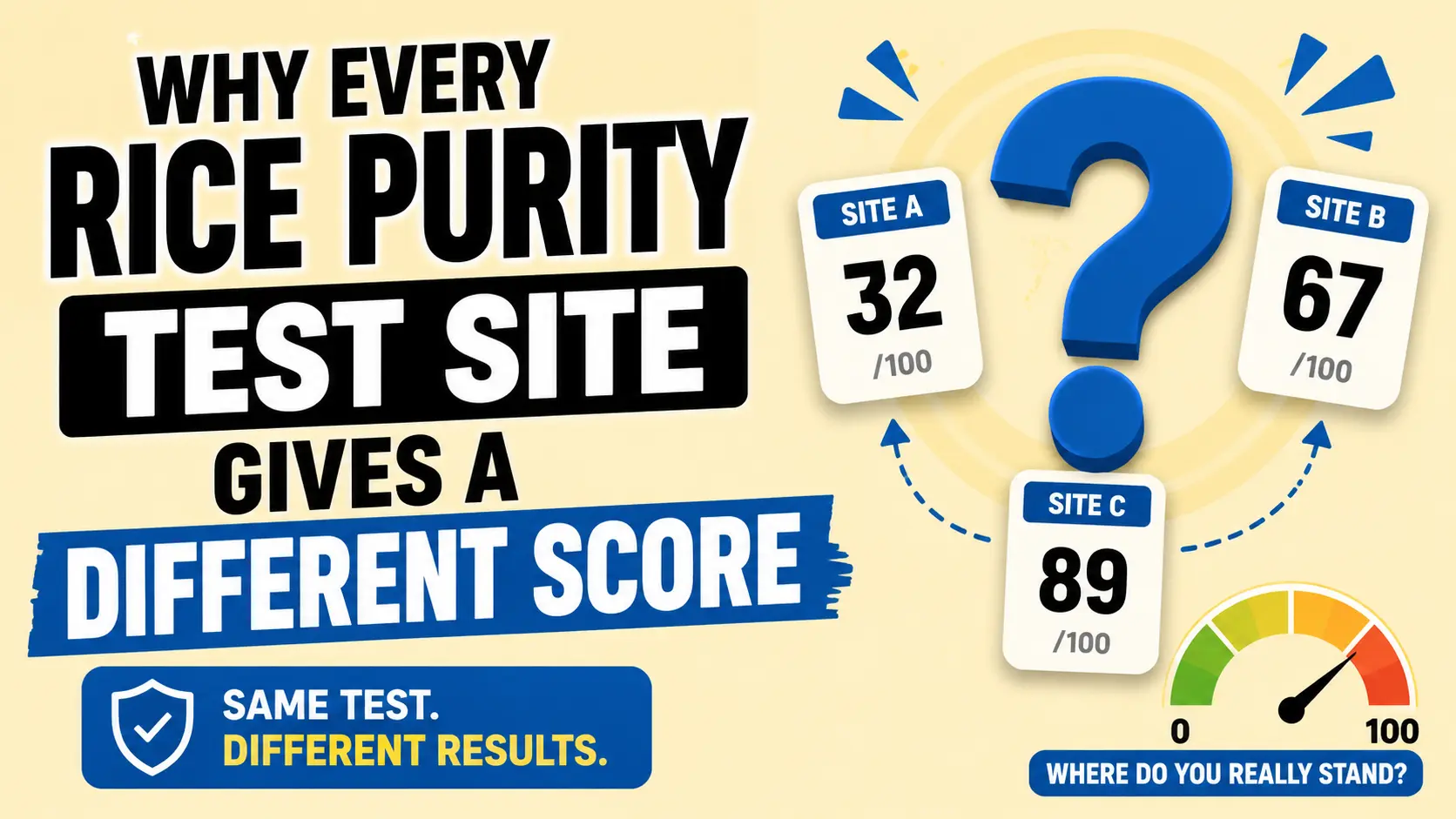
You take the Rice Purity Test, get a 68, then take it again on another site an hour later and get a 74. Nothing about your life changed in that hour.
This confuses a lot of people, and it makes some assume one of the sites is broken or rigged. Neither is usually true.
The Rice Purity Test has no central authority, no verified answer key, and no single owner enforcing a standard. What circulates online is a family of related checklists, and small differences between them produce very different numbers.
Quick Answer: Rice Purity Test sites give different scores because they use different question counts, different question sets, different wording, different scoring scales, and different interface behavior. A 100-question site and a 150-question site cannot produce the same number even if you answer with perfect honesty on both. The number is a property of the version you took, not a fixed fact about you.
If you want the baseline meaning first, start with our guide to what your Rice Purity score actually means, then come back here for why that number moves.
Why Does the Same Person Get Different Rice Purity Scores on Different Sites?
Definition: Score variance on the Rice Purity Test is the gap between results produced by two different versions of the same checklist. It is caused by version differences, not by inconsistency in the person answering.
There are seven mechanical reasons a score moves between sites:
- Question count — 100, 150, 50, or 20 items depending on the site
- Scoring scale — out of 100 versus out of 150, or converted to a percentage
- Question set — which items were kept, cut, or replaced
- Wording — a softened or sharpened item flips your answer
- Interface mechanics — pre-checked boxes, skipped items, unanswered defaults
- Your own recall — you answer slightly differently each sitting
- Interpretation — sites label the same number differently
Insight: Reasons one through five change the number itself. Reasons six and seven change what the number appears to mean.
Reason 1: Not Every Site Uses the Same Number of Questions
The test has never had a stable length. It grew, shrank, and forked repeatedly across a hundred years, and every one of those forks is still online somewhere.
| Version | Items | Where you still find it |
|---|---|---|
| 1924 Thresher original | 10 | History articles and archives |
| 1988 expanded edition | 150 | A handful of “historical version” sites |
| Modern standard | 100 | The vast majority of sites, including this one |
| Short and teen editions | 20–50 | School-safe and “quick test” pages |
| Long-form campus purity tests | 400–2,000 | Archived university and Usenet copies |
What this means: If you scored 68 on a 100-item test and 112 on a 150-item test, you did not become purer. You answered fifty more questions on a longer scale.
Read more: History of the Rice Purity Test: origin and viral journey.
Reason 2: The Scoring Scale Is Not Always Out of 100
People Also Ask: Is the Rice Purity Test always scored out of 100?
No. The standard modern method is simple subtraction: start at 100, subtract one point for every item you check. But sites running the 150-item edition start at 150 and subtract from there, and a few display the result as a percentage instead of a raw score.
To compare two scores fairly, normalize them:
Formula: (your score ÷ total questions) × 100 = comparable percentage
- 68 out of 100 → 68%
- 102 out of 150 → 68%
- 34 out of 50 → 68%
Insight: Three completely different-looking numbers can describe an identical answer pattern. Until you normalize, you are comparing nothing.
Reason 3: The Question Sets Themselves Have Drifted
Even among sites that all use exactly 100 questions, the hundred are not always the same hundred.
Over the decades, editors added items, removed items they later regretted, and rewrote gendered language into the neutral abbreviation MPS so the test worked for everyone. It is widely reported that a late-1990s revision was the turning point that produced the gender-neutral format most online copies inherited.
The drift did not stop there. A wave of “modern” and “2026 edition” rebuilds swap classic items for contemporary ones — dating apps, group chats, streaming, social media behavior — while keeping the familiar 100-item shell and the same subtraction scoring.
- Items added that never existed in the classic list
- Items quietly dropped for being dated or offensive
- Categories weighted differently by how many items each gets
- Whole sections omitted on sites that want a tamer page
What this means: A version stacked with modern digital-life items will pull most people’s scores down, because those experiences are near-universal. A version that trims its most-checked items will push scores up.
See also: Rice Purity Test questions explained and what MPS means on the Rice Purity Test.
Reason 4: Wording Changes Turn a “Yes” Into a “No”
This is the difference most people never notice, and it is the largest single source of variance between two 100-question sites.
Many sites soften the original phrasing to stay advertiser-friendly or age-appropriate. Others sharpen it. The same underlying experience can be described in a way you would check, or a way you would skip.
| Wording style | Effect on your answer | Effect on your score |
|---|---|---|
| Vague or euphemized | You are unsure whether it applies, so you leave it blank | Score rises |
| Broad and inclusive | More situations qualify, so you check it | Score falls |
| Narrow and specific | Your experience does not quite match, so you skip it | Score rises |
| Qualifiers like “more than once” | A single instance no longer counts | Score rises |
A single ambiguous word can swing several items. Across a hundred questions, that adds up to a five to ten point gap on its own.
Related: Rice Purity Test question 69 explained — a good example of how one item gets misread constantly.
Reason 5: Interface Mechanics Quietly Change Your Total
People Also Ask: Can a website’s design change my Rice Purity score?
Yes, and this is worth checking before you trust any result.
- Pre-checked boxes. Some pages ship a checked promotional row or a checked first item, silently costing you a point before you begin.
- Checkbox versus yes/no buttons. A checkbox treats “not clicked” as a no. A forced yes/no format makes you decide on every item, and people say yes more often when forced to choose.
- Skipped questions. Some sites count an unanswered item as a no. Others block submission. Others count it as a yes.
- Reset and back-button bugs. Navigating away and returning can clear or double-count answers on poorly built pages.
- Auto-scroll and pagination. Multi-page tests hide items below the fold that get missed entirely.
Insight: Before comparing scores with a friend, scroll to the top of both tests and confirm every box starts empty.
Reason 6: You Answer Slightly Differently Each Time
The Rice Purity Test is self-reported, unverified, and taken from memory. That makes the test-taker part of the measuring instrument.
- Recall. You remember more items on a second pass than a first.
- Threshold drift. “Does that really count?” gets answered differently depending on your mood.
- Audience. Taking it alone produces different answers than taking it with friends watching your screen.
- Privacy perception. A site that looks like it stores answers makes people under-report.
- Performance. Some people deliberately aim low or high for social effect.
What this means: Even on one identical site, retaking the test a week later commonly moves your score by a few points. That is normal and expected for any self-report checklist.
Reason 7: Sites Interpret the Same Number Differently
Two sites can hand you the identical score of 72 and label it two different things. There is no agreed rubric, so each site publishes its own bands.
| Published claim | What it implies about a 72 |
|---|---|
| “Good” starts in the mid-80s | 72 looks below average |
| “Normal” runs 50 to 85 | 72 sits comfortably mid-range |
| “Balanced” runs 40 to 60 | 72 looks relatively sheltered |
The number did not move. The label did.
For a consistent framework, use our own breakdowns: what counts as a good Rice Purity score, is 70 a good score, is 50 a bad score, and what a 0 actually means.
Why the Published Averages Do Not Match Either
If versions differ, averages built from those versions differ too. The most-quoted historical figure comes from the Rice Thresher’s own tally: an average near 61.5 across roughly 125,000 submissions, with data that stopped being updated years ago.
Other sites publish age-banded numbers that run far higher — into the 90s for under-18s and the mid-80s for under-25s — while some contemporary trackers report a global average in the low 60s. All of these can be simultaneously accurate for the population that took that particular test on that particular site.
- Different question sets produce different score distributions
- Different audiences — a TikTok-driven site skews younger than a college forum
- Self-selection — people who expect an interesting score are likelier to submit
- Different time periods — a 2018 dataset and a 2026 dataset are not the same population
- No verification — nothing prevents joke submissions from entering the pool
Compare the numbers yourself: live Rice Purity Test statistics, the average Rice Purity score by age, gender and country, and the average score in the USA.
Myth vs Reality: Score Differences Between Sites
| Myth | Reality |
|---|---|
| One site is the official version | No site is officially operated by Rice University today |
| A different score means you lied somewhere | Different question sets produce different totals from honest answers |
| All sites use the same 100 questions | Counts, wording, and item pools all vary |
| Higher score equals a better person | The score reflects exposure, not character or worth |
| The averages online are verified data | They are self-reported and unaudited |
| Score differences are a bug | They are the predictable result of version drift |
How to Get a Rice Purity Score You Can Actually Compare
If you want a number that means something next to your friend’s, control the variables:
- Use one site for everyone. Same URL, same session, same day.
- Confirm the question count before starting, and confirm it is the same for both of you.
- Check that no boxes start pre-checked.
- Agree on borderline rules in advance — does a single instance count, or does it need to be more than once?
- Take it privately, then share the number rather than answering with people watching.
- Normalize if the scales differ using the percentage formula above.
Insight: The comparison is only meaningful when the instrument is identical. Everything else is comparing two different tests.
Taking it as a pair? Our Rice Purity Test for couples is built for exactly that, with a fixed shared question set.
Which Rice Purity Test Version Should You Trust?
Direct answer: Trust the version that is transparent about three things — how many questions it asks, how it calculates the score, and whether it stores your answers. Any site that hides those is not more accurate, it is just less clear.
There is no accuracy ranking to win here, because there is nothing objective to be accurate about. The test measures self-reported exposure to a specific list of experiences. Change the list and you change the measurement. That is not a flaw in any one site; it is the nature of the format.
Our version uses the classic 100-question format with straightforward subtraction scoring, and your answers stay in your browser. You can take the Rice Purity Test here and read the full explanation of scores and meaning alongside it.
Does a Different Score Mean One Site Is Wrong?
No. It means you took two different tests that share a name.
The useful takeaway is not which number is correct, but what the range tells you. If you score between 65 and 75 across four different sites, that band is a far more honest picture of your experience level than any single number from any single page.
Final insight: Treat the Rice Purity Test as a conversation starter with a rough scale attached, not as a measurement. It was invented as an icebreaker, and it still works best as one.
Go deeper: what your Rice Purity score actually indicates about you, or read more on the Rice Purity Test blog.
Frequently Asked Questions
Because the two sites almost certainly used different question sets. Sites vary in question count, wording, scoring scale, and interface behavior, so the same honest answers produce different totals. The gap is caused by the version, not by you.
None of them are accurate in a scientific sense, because there is no verified standard to measure against. The most trustworthy sites are the ones that state their question count, explain their scoring method, and keep your answers in your browser.
The modern standard is 100 questions. Historically the test has run at 10 questions in 1924 and 150 questions in 1988, and short 20 to 50 question editions circulate online today. All of these are described as the Rice Purity Test.
Divide your score by the total number of questions and multiply by 100. A 102 out of 150 and a 68 out of 100 are the same result, both equal to 68 percent.
Yes. Pre-checked boxes, items counted as answered when they were skipped, and multi-page layouts that hide questions can all shift your total. Scroll to the top and confirm every box starts empty before you begin.
Yes, in two ways. Your score naturally decreases as you gain more of the listed experiences, and it can also shift a few points on a retake simply because you remembered more items or judged a borderline question differently.
No. The test originated in the Rice Thresher, Rice University’s student newspaper, but no website today is officially operated or endorsed by the university. Every online version is an independent copy.
A range is more useful than an average. If you land between 65 and 75 across several sites, that band describes your experience level more honestly than any single number.
