
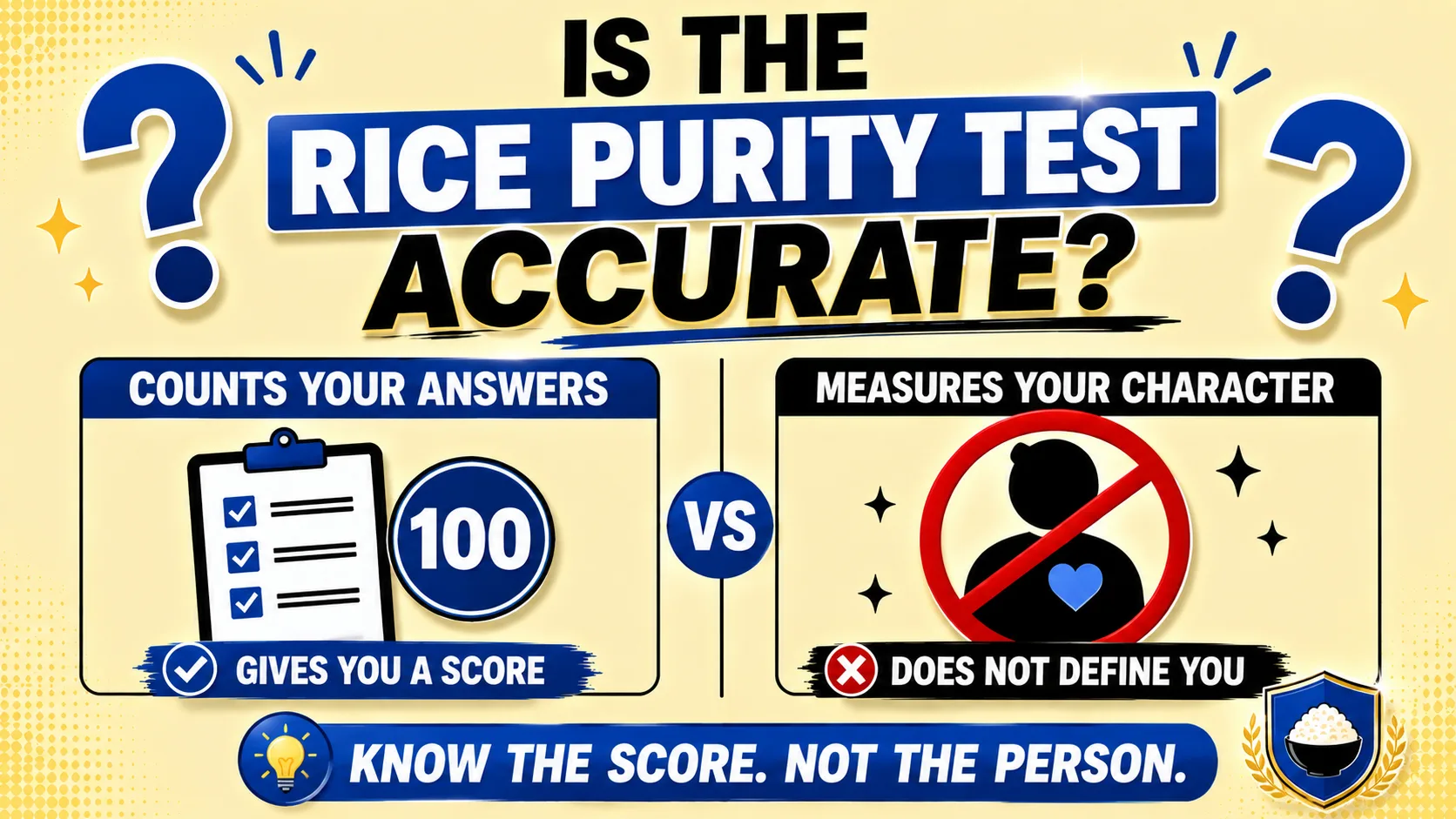
The Rice Purity Test gives you a precise-looking number out of 100, which makes it feel like a measurement. It is worth being clear about what that number can and cannot tell you.
Quick Answer: The Rice Purity Test is accurate at exactly one thing — counting how many of 100 listed experiences you check. It is not a validated psychological instrument, has never been through reliability or validity testing, and cannot measure maturity, morality, or wellbeing. The score is a tally, not an assessment.
What “Accurate” Means for a Test Like This
Definition: In psychometrics, a test is judged on two separate things — reliability, meaning it produces consistent results, and validity, meaning it actually measures what it claims to measure.
The Rice Purity Test does reasonably well on the first and fails the second entirely. If you answer honestly today and again next week, you will get the same score. The arithmetic is simple and deterministic, so it is consistent by design.
What this means: Consistency is not the same as meaning. A test can produce the same number every time and still be measuring nothing useful. The Rice Purity Test is reliable in the narrow sense and invalid in the important one.
Where the Test Fails
People Also Ask: Is the rice purity test scientifically valid?
No. It originated as a student icebreaker at Rice University and was never designed as an assessment. Five structural problems prevent the score from meaning what people assume it means:
- Every item weighs the same. Holding hands and a criminal conviction each subtract one point. The score cannot distinguish fifty mild experiences from fifty serious ones. See the full list of all 100 questions to see how uneven the items are.
- There is no time axis. Someone who did everything on the list across fifteen years scores identically to someone who did it all in one. Those are very different lives producing the same number.
- There is no context. The test never asks whether an experience was wanted, regretted, safe, or meaningful. It only counts.
- “Purity” is not a defined construct. The test claims to measure something it never defines, which is the clearest single reason it has no standing as an assessment.
- It relies entirely on self-report. Nothing is verified. People inflate their answers to seem experienced and deflate them to seem reserved, often in the same room.
Where the Numbers Do Hold Up
Insight: The test is a poor instrument, but the aggregate data it produces is more solid than the individual scores.
Three things survive scrutiny:
- Sample size. Our live statistics draw on over 125,000 real submissions. At that volume, individual exaggeration in both directions largely cancels out, and the shape of the distribution is stable.
- Anonymity reduces one major bias. Group settings distort answers heavily because people are performing for each other. Anonymous online submission removes that pressure, which makes aggregate figures more trustworthy than any classroom or party version of the test.
- Directional trends are real. Scores fall with age, and they fall faster in college environments. That pattern is robust across the dataset and matches what you would expect, even if any single score is noisy.
Where the Data Has Real Limits
Being straight about this matters more than defending the numbers. Three caveats apply to every statistic on this site:
- The sample is self-selected. These are people who chose to take an online purity test, which skews young and social-media-driven. They are not a representative sample of any population, and the figures should never be read as population statistics.
- Nothing is verified. We record final scores anonymously and have no way to confirm any of them. Joke submissions are real and cluster at the extremes, which is why a score of 0 should not be taken literally.
- Score bands are coarse. Percentile figures are grouped into ranges, so they are accurate within a few points rather than exact. Our percentile breakdown explains how those bands are calculated.
Why the Score Feels More Meaningful Than It Is
Two things create a false sense of precision. The first is the scale — a number out of 100 looks like a grade, and people read it as one. The second is the decimal-level averages that sites like this one publish, which suggest a measurement instrument rather than a tally of checkboxes.
What this means: A score of 74 is not meaningfully different from a score of 76. Treat the band, not the digit, as the signal. The full score chart is built around ranges for exactly this reason.
Accuracy: Myth vs Reality
| Common Belief | Reality |
|---|---|
| The test was developed by psychologists | It began as a student icebreaker at Rice University with no clinical involvement. |
| A precise score means a precise measurement | The precision comes from arithmetic, not from anything being measured accurately. |
| The test measures maturity or morality | It counts experiences. It has no mechanism for evaluating any of them. |
| Online results are less reliable than in-person ones | The reverse. Anonymity removes the peer pressure that distorts group settings most. |
| The published averages apply to everyone | They describe people who chose to take an online quiz — not any general population. |
| A one-point difference matters | Single points are noise. Only broad bands carry any signal at all. |
So Should You Take It Seriously?
As entertainment and a conversation starter, it works — that is what it was built for. As a measure of anything about you, it does not, and no amount of data volume changes that.
If a specific experience behind your score is sitting badly with you, that is worth talking through with someone you trust. The number itself will not help you think about it, because it was never designed to.
Frequently Asked Questions
It accurately counts how many of the 100 listed items you check, and nothing beyond that. It is not a validated psychological instrument and cannot measure maturity, morality, or wellbeing.
No. It was created as a student icebreaker at Rice University and has never undergone reliability or validity testing. It also never defines what “purity” means, which alone disqualifies it as an assessment.
It originated at Rice University as an orientation-week icebreaker for incoming students. It was designed to spark conversation, not to measure anything.
Aggregate figures from large anonymous samples are reasonably stable, because individual exaggeration in both directions tends to cancel out. Individual scores remain unverified self-report and should not be read as fact.
Wording varies between versions, and some sites soften or reword items. Since every item costs one point regardless of what it describes, different phrasing produces different scores for the same person.
No. There is no verification of any kind, and no internal consistency check. The test records exactly what you enter.
No. The score counts experiences without weighing severity, timing, or context, so it cannot support any conclusion about a person.
Take the test if it sounds fun, then read the result for what it is — a count of checked boxes, not a measurement of anything.
