
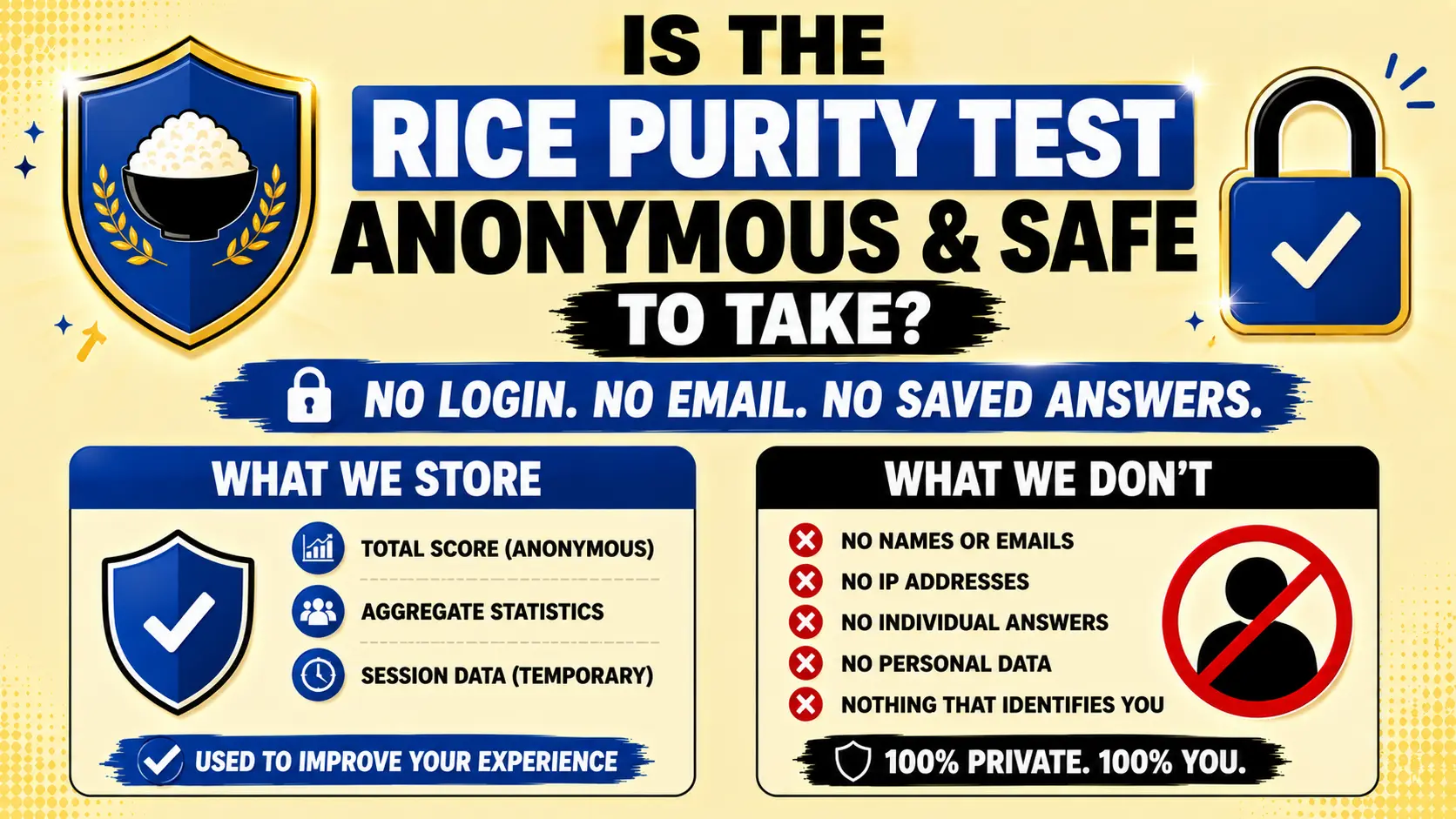
Taking a test that asks about your private life on a website you have never used before is a reasonable thing to hesitate over. Here is exactly what happens to your answers on this site.
Quick Answer: Yes. The Rice Purity Test on this site requires no account, no email, and no personal details. Your individual answers are never saved — the only thing recorded is your final score as an anonymous number, with no way to connect it back to you.
What We Store
Exactly two things are recorded when you finish the test:
- Your final score. A single number between 0 and 100, stored as an anonymous count with no identifier attached.
- Your country. Determined from your connection at the moment of submission and stored only as a country-level total, never alongside your score.
That is the entire dataset. It powers the aggregate figures on our live statistics page, where every number is a total across all submissions rather than anything about a single person.
What We Don’t Store
Definition: Answer-level tracking means recording which specific questions someone checked. This site does not do that.
- Your individual answers. Which boxes you checked is calculated in your browser and discarded the moment your score is produced.
- Your name or email. Neither is ever requested.
- An account. There is no sign-up, no login, and no profile.
- Your IP address. Used momentarily to determine your country, then discarded rather than stored.
- Anything linking submissions together. Take the test ten times and you produce ten unconnected entries.
What this means: Even we cannot look up what any individual answered, because that information was never written down. There is no record to request, leak, or subpoena.
Why There Is No Sign-Up
Insight: The most reliable privacy guarantee is not collecting data in the first place.
Sites that require an account can link your answers to an identity, and that link persists whether or not anyone ever uses it. Because this test never asks who you are, there is nothing to secure. It also produces better data — anonymity removes the pressure that makes people exaggerate, which is part of why the aggregate figures hold up. We cover that in more detail in is the rice purity test accurate.
Is It Safe to Take on a Shared Device?
People Also Ask: Can someone see my rice purity test results?
Nothing about your result is stored on our end that could be shown to anyone. The realistic risks are all local to your own device:
- Browser history. The page you visited appears in history like any other. Clear it or use a private window.
- The screen itself. Your score displays after submission, so anyone nearby can see it.
- Sharing it yourself. Most scores that circulate were posted voluntarily. That is the main way results become public.
What About Ads and Analytics?
Being precise here matters more than sounding reassuring. Our test does not track your answers — that is entirely within our control and stated above. Separately, like most websites, this site may use standard analytics and advertising tools that operate independently of the test itself and follow their own policies.
What this means: Those tools never receive your answers or your score, because the test does not pass that information to anything. If you want to limit them, a private browsing window or a content blocker handles it.
Should Younger Users Take It?
The test covers adult topics and was written for a college audience. It is worth being aware of that before taking it, regardless of what any score turns out to be.
Whatever number appears, it counts checked boxes and nothing else — it is not a judgment, and it does not follow you anywhere. Our guide to what counts as a bad score covers why no result means what people assume.
Privacy: Myth vs Reality
| Common Belief | Reality |
|---|---|
| The site saves which questions you checked | Individual answers are calculated in your browser and never stored anywhere. |
| You need an account to see your score | There is no sign-up, login, or email step at any point. |
| Your score is tied to your identity | Scores are stored as anonymous numbers with no identifier attached. |
| Retaking the test builds a profile | Submissions are unconnected. Ten attempts produce ten unrelated entries. |
| Someone could look up your result | There is no record to look up, including for us. |
| Scores leak from the site | Results that circulate were shared voluntarily by the people who took the test. |
Frequently Asked Questions
Yes. No name, email, or account is required at any point, and your final score is stored as an anonymous number with no identifier attached to it.
No. Which questions you checked is calculated in your browser and discarded once your score is produced. Only the final number is recorded.
No. There is no registration, login, or email step. You take the test and see your score immediately.
No. Nothing links a score to a person, so there is no record for anyone to retrieve — including us. Scores become public only when people share them themselves.
Yes. Nothing is installed and no permissions are requested. The only local trace is the page in your browser history, which you can clear or avoid with a private window.
Two things: your final score as an anonymous number, and your country, stored only as a country-level total. Nothing else about your submission is retained.
There is nothing identifiable to delete, since no submission is linked to a person. Your score exists only as part of an anonymous total.
Take the test whenever you like — no account, no email, and no record of what you answered.
