
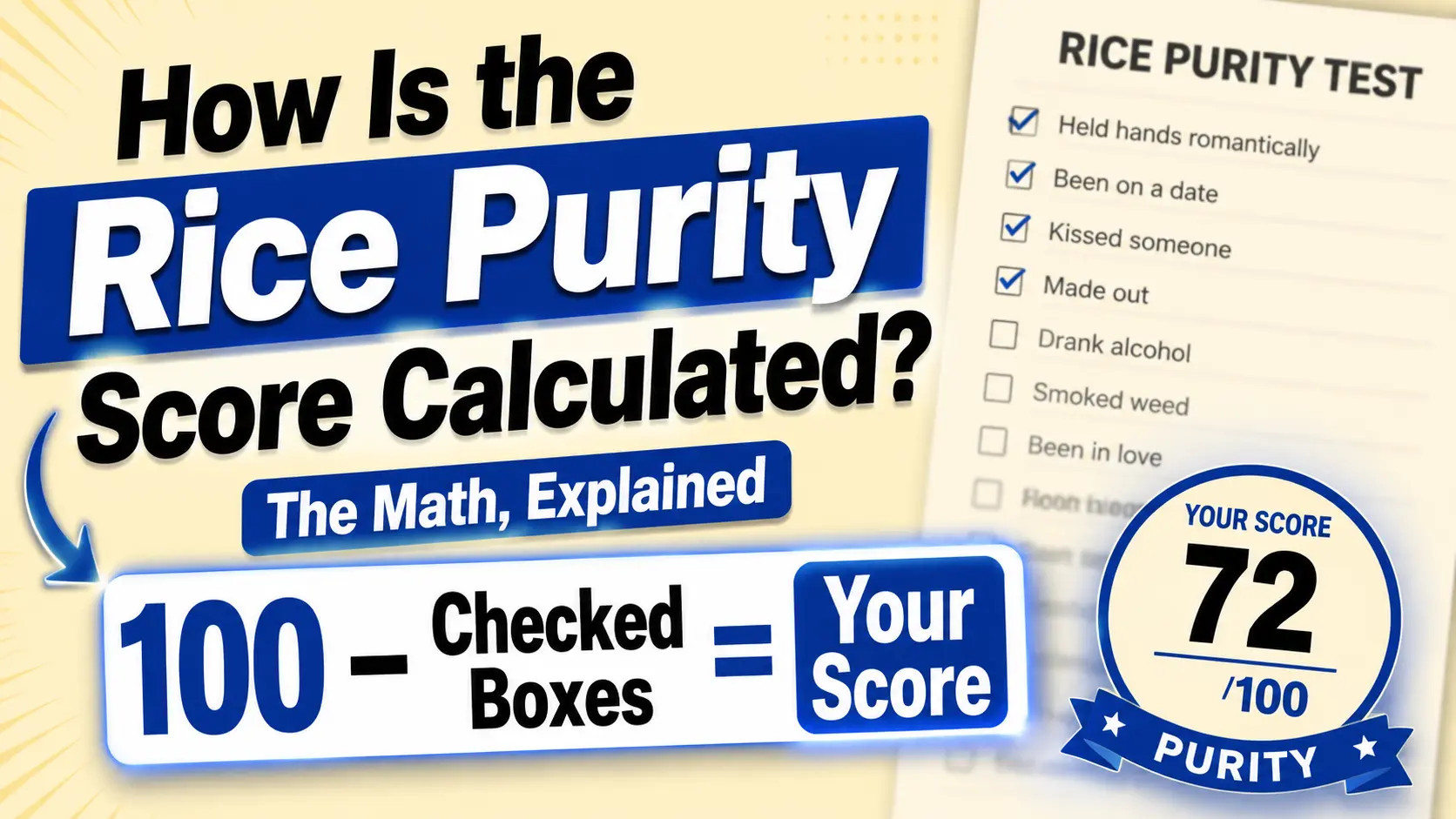
The Rice Purity Score looks like it involves some kind of weighting or formula. It does not. The calculation is a single subtraction, and knowing it changes how much weight the number deserves.
Quick Answer: Your rice purity score equals 100 minus the number of questions you check. Every item is worth exactly one point, whether it describes holding hands or a criminal conviction. Check 24 boxes and you score 76. Check none and you score 100.
The Formula
Definition: The Rice Purity Score is a subtraction from a fixed starting value of 100, with one point deducted per checked item.
Written out:
Score = 100 − (number of questions you checked)
That is the entire calculation. There is no weighting, no category multiplier, no partial credit, and no adjustment for age or context. The test does not know which questions you checked — only how many.
A Worked Example
Say someone works through all 100 questions and checks the following:
- 8 items in the dating and romance section
- 7 items in the kissing and affection section
- 4 items covering solo experiences
- 3 items covering alcohol
- 2 items covering minor rule-breaking
That totals 24 checked boxes. The calculation runs:
100 − 24 = 76
Their score is 76. That number happens to be the median result across submissions on this site, meaning half of all test-takers score above it and half below. See our complete rice purity score chart for what each range indicates.
How to Reverse the Calculation
Insight: Because the math runs one direction, it also runs the other. Your score tells you exactly how many items you checked.
Questions checked = 100 − your score
- A score of 90 means 10 items were checked.
- A score of 76 means 24 items were checked.
- A score of 50 means exactly half the list was checked.
- A score of 0 means all 100 were checked, which is why a score of 0 should rarely be taken at face value.
Why Every Question Is Worth One Point
People Also Ask: Are some rice purity questions worth more than others?
No, and this is the most consequential thing about the calculation. The test applies no severity weighting whatsoever. A mild item and an extreme item both cost a single point, which produces some strange results.
Two people can score an identical 60 while having almost nothing in common — one checked forty mild items and no serious ones, the other checked twenty mild items and twenty serious ones. The arithmetic cannot tell them apart, because it was never designed to. Our page on whether the test is accurate covers what this means for interpreting any score.
What the Calculation Does Not Include
Four things people assume are factored in, and are not:
- Severity. No item is weighted more heavily than any other.
- Timing. Something from last week and something from ten years ago count identically.
- Frequency. Checking an item once and doing something a hundred times produce the same single point.
- Context. The test never asks whether an experience was wanted, safe, or regretted.
What this means: The score is a count, not a summary. It compresses a hundred yes-or-no answers into one number and discards everything that made those answers different from each other.
Why Scores Only Go Down
Since each checked item permanently subtracts a point, a score can never rise on an honest retake. It either stays the same or falls as more items become true over time.
This is the mechanism behind the age effect. Scores drop steadily from the mid-teens into the twenties simply because ordinary milestones accumulate, which is why the average rice purity score differs so much between age groups. Nothing about the person changes — only the count.
Calculation: Myth vs Reality
| Common Belief | Reality |
|---|---|
| Serious questions deduct more points | Every item deducts exactly one point, regardless of what it describes. |
| There is a hidden formula or algorithm | The whole calculation is 100 minus the number of checked boxes. |
| Skipping questions lowers your score | Unchecked and skipped items are treated the same — neither deducts anything. |
| The score adjusts for your age | No adjustment of any kind is applied. Two people checking 24 items both score 76. |
| You can improve your score over time | Scores only stay the same or fall, since checked items never become unchecked. |
| The site knows which questions you checked | Only the final number is recorded — see what this site does and doesn’t store. |
Frequently Asked Questions
Your score equals 100 minus the number of questions you check. Each checked item deducts exactly one point from a starting total of 100, with no weighting applied to any item.
One point each. Every question on the test carries identical weight, whether it describes a mild experience or an extreme one.
It means 24 items were checked, since the score is 100 minus the number of boxes. This works for any score — subtract it from 100 to get the count.
No. Skipping a question and leaving it unchecked are treated identically, and neither deducts any points.
No. Because each checked experience permanently subtracts a point, an honest retake can only produce the same score or a lower one.
The formula is the same everywhere, but wording varies between versions. Since every item costs one point regardless of phrasing, different versions can produce different scores for the same person.
No. The test applies no adjustment for age, timing, frequency, or circumstance. It counts checked boxes and nothing else.
Take the test to see your own count, then read the result as what it is — a subtraction, not an assessment.
