
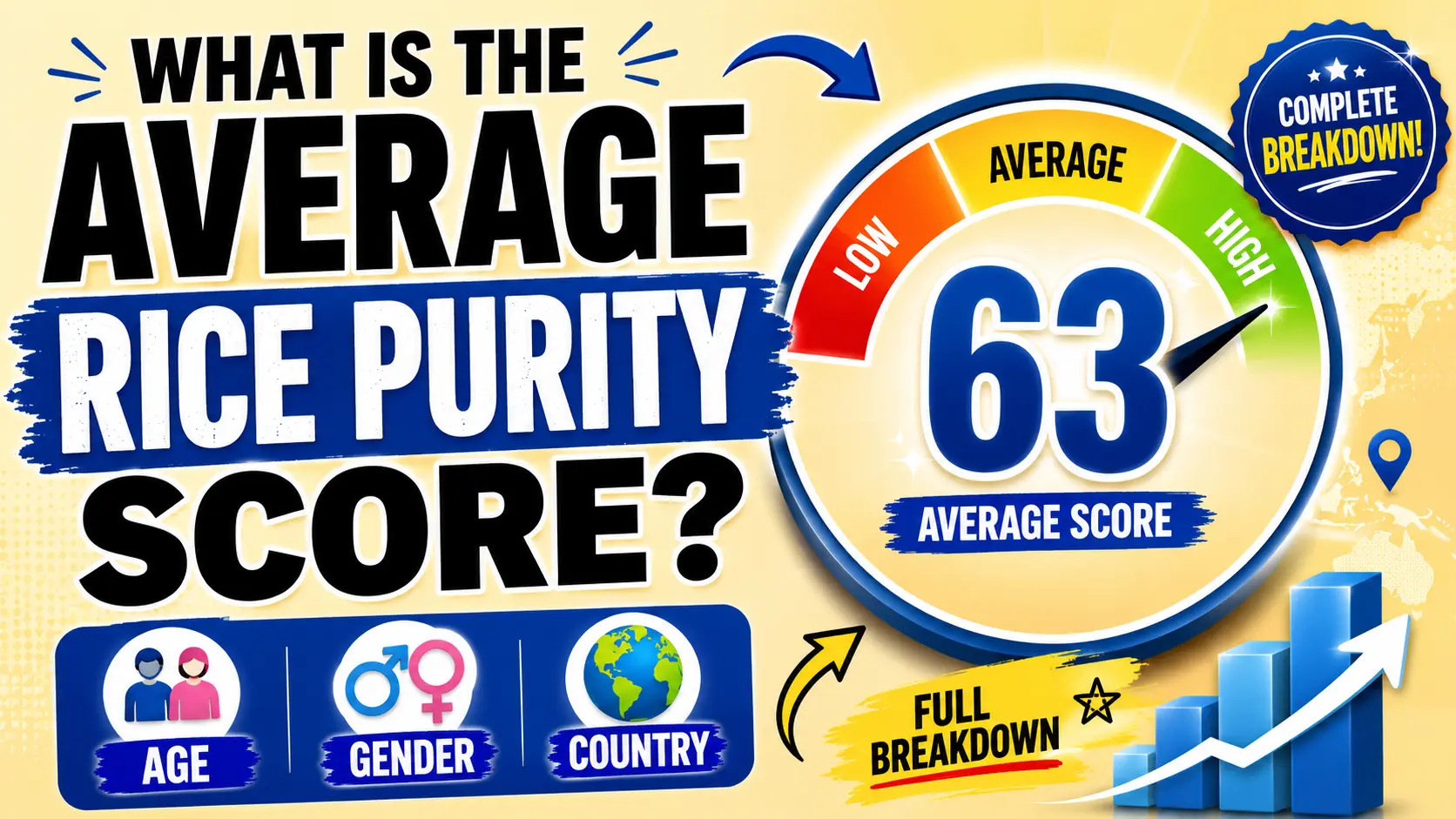
TL;DR – The numbers at a glance
- Global average: 63–65 (Source: Rice Thresher, 124,952 submissions)
- Most people score between 60 and 75
- Scores drop significantly with age – roughly 10–15 points per bracket
- Women average higher (~71) than men (~65)
- Your score is completely normal – whatever it is
Key Takeaways
- The global average rice purity score is 63–65, based on the largest publicly available dataset of 124,952 submissions.
- Age is the strongest predictor of your score – a 16-year-old averaging 85 and a 22-year-old averaging 60 are both completely on track.
- Women score about 6 points higher than men on average, but the overlap between groups is far larger than the gap.
- The sharpest score drop happens between ages 17 and 21 – the college transition years account for most of the change.
- A score of 0 is nearly impossible – fewer than 0.3% of test-takers hit it, and the test includes items almost no one has experienced.
What Is the Average Rice Purity Score?
The global average rice purity score is 63–65, based on 124,952 submissions collected by the Rice Thresher, Rice University’s official student newspaper. That’s the most cited benchmark in the data, and it holds up perfectly in large-scale survey datasets.
In plain English: if you scored 65, you’re dead average. If you scored above 65, you’ve had fewer of the experiences on the test than most people. Below 60, you’ve had more.
Most people land between 60 and 75. That range covers the majority of test-takers across all demographics. Scores below 45 or above 95 are genuinely uncommon – both tails of the distribution are thin.
One thing worth knowing: the rice purity test average score shifts depending on the sample. A dataset skewed toward college students will pull the average down. A sample with more teenagers will push it up. The 63–65 figure is the broadest, most reliable benchmark we have – treat it as a reference point, not a verdict.
Average Rice Purity Score by Age
Age is the single biggest predictor of your rice purity score. Full stop.
| Age Group | Average Score | What It Means |
|---|---|---|
| Under 16 | 90–95 | Very limited experience – totally normal |
| 16–17 | 80–88 | Early exploration stage |
| 18–20 | 68–76 | College freshman range |
| 21–23 | 58–65 | Peak college experience years |
| 24–28 | 50–60 | Post-college, more life experience |
| 28+ | 45–55 | Broader life experience accumulated |
Scores drop roughly 10–15 points per age bracket on average. The sharpest single drop happens between 17 and 21 – the college transition years, when people encounter the social situations the test was originally designed to capture. If you’re 18–20 and scored 68–76, you’re exactly average for your age group. Not above it, not below it – right in the middle.
What Is the Average Rice Purity Score for a 16-Year-Old?
The average rice purity score for a 16-year-old is 80–88. This is the pre-college range. Most 16-year-olds have held hands, had a first kiss, maybe gone on a few dates – but they haven’t encountered the college-specific experiences the test was built around. A score of 85 at 16 is completely average. Don’t benchmark yourself against older age groups; the test wasn’t designed for you yet, and your score reflects that accurately.
What Is the Average Rice Purity Score for College Students?
College students average 58–67, depending on their year. Freshmen aged 18–19 typically score 68–76. By junior and senior year – ages 21–22 – that average drops to 58–65. The college years are when the biggest score drops happen, because students encounter new social environments, relationships, and situations the test explicitly covers. If you’re in college and scored anywhere from 60–70, you’re right in the middle of the pack for your demographic.
What Is the Average Rice Purity Score for a 14-Year-Old?
The average rice purity score for a 14-year-old is 90–98. At 14, most people have very limited experience with the activities the test covers. A score of 90 or above isn’t just normal at that age – it’s expected. The test was created for college freshmen at Rice University, so many of its questions simply don’t apply to younger teenagers yet. Don’t compare your score to older age groups; the comparison isn’t meaningful.
Average Rice Purity Score by Gender
Gender shows a consistent, measurable gap in rice purity test averages – but it’s smaller than most people assume.
| Gender | Average Score | Notes |
|---|---|---|
| Women | ~71 | Consistently higher across all age groups |
| Men | ~65 | Lower average, more variance in scores |
| Non-binary | ~63 | Based on community surveys |
(Source: Community survey data via Reddit r/SampleSize)
The gender gap narrows significantly with age. By 28+, the difference between men and women is typically less than 5 points. These are averages – individual scores vary enormously within each group. A woman scoring 40 and a man scoring 85 are both completely normal. The overlap between groups is massive; knowing someone’s gender tells you almost nothing about their specific score.
Do Girls Score Higher Than Boys on the Rice Purity Test?
Yes, on average. Women score approximately 6 points higher than men across all age groups – roughly 71 vs. 65. However, this gap is smaller than most people expect, and the distribution of scores within each gender is wide. Your gender doesn’t determine your score. Your experiences do. The 6-point average difference is a statistical pattern across large samples, not a rule that applies to any individual.
Average Rice Purity Score by Country
Cultural background has a significant impact on rice purity scores. The test originated in the US college context, so countries with similar social norms tend to cluster near the global average – while countries with more conservative or more liberal cultural attitudes toward relationships score noticeably higher or lower.
| Country / Region | Average Score | Notes |
|---|---|---|
| USA | 67–69 | Broad range; college culture drives lower scores (see USA breakdown) |
| UK | 68–71 | Similar to USA, slightly higher |
| Philippines / SE Asia | 78–85 | Cultural conservatism reflected in scores |
| Brazil / Latin America | 55–62 | More open attitudes toward relationships |
| India | 75–85 | Conservative cultural norms |
| Australia | 65–70 | Similar to USA/UK range |
| Canada | 66–70 | Close to US average |
(Note: country-level figures are community-reported averages from Reddit surveys and online communities, not peer-reviewed academic studies. Treat them as directional benchmarks.)
SE Asian and South Asian scores tend to run higher due to more conservative social norms around premarital relationships and dating. Latin American scores trend lower, reflecting more open cultural attitudes. The USA and UK cluster near the global average because the test was designed for that demographic. If you’re outside the US, your score will naturally diverge from the headline average – and that’s expected.
What Does Your Rice Purity Score Mean?
Here’s a clean breakdown of what each score range actually represents – no judgment, just context.
| Score Range | Label | What It Means |
|---|---|---|
| 98–100 | Innocent | Very limited life experience – totally normal for younger users |
| 90–97 | Pure | Some experiences, mostly conservative |
| 77–89 | Relatively Pure | Average for teens and young adults |
| 65–76 | Average | Right in the middle of the global average |
| 45–64 | Experienced | You’ve explored more than most – no judgment |
| 9–44 | Very Experienced | Significant life experience across many categories |
| 0–8 | Extremely Rare | Almost no one scores this low |
Is 70 a Good Rice Purity Score?
Yes – 70 is above the global average of 63–65. It means you’ve had some experiences but fewer than most people your age. → Is 70 a Good Rice Purity Score? Whether that’s “good” is entirely up to your own values; the test doesn’t judge, it just measures. For college freshmen, 70 is right in the average range. For upperclassmen, it’s above average. → See our full guide: Is 70 a Good Rice Purity Score?
Is 50 a Bad Rice Purity Score?
No. A score of 50 means you’ve experienced roughly half the items on the 100-question test – which puts you below the global average but nowhere near rare territory. → Is 50 a Bad Rice Purity Score? For anyone over 24, a score of 50–60 is completely normal. The test measures experience, not character. → Is 50 a Bad Rice Purity Score?
What Does a Score of 0 Mean?
A score of 0 means you checked every single item on the test. → What Does a 0 Mean on the Rice Purity Test? This is extremely rare – fewer than 0.3% of test-takers score 0. It’s also worth noting the test includes some items that are nearly impossible to have experienced, which means a true 0 is almost certainly inaccurate. → What Does a 0 Mean on the Rice Purity Test?
Is 80 Above Average?
Yes. A score of 80 is well above the global average of 63–65. It’s typical for people aged 16–17 or for adults who’ve had more conservative life experiences. There’s nothing wrong with an 80 – it simply reflects your personal history. For a 25-year-old, 80 is notably above average. For a 15-year-old, it’s right on track.
How to Compare Your Rice Purity Score
Got your number? Here’s how to actually use it.
- Compare to your age group first. The age table above is your most relevant benchmark – not the global average, which pools everyone together.
- Don’t compare to people significantly older or younger. A 30-year-old and a 16-year-old will almost always score very differently, and that’s by design.
- The test was built for college freshmen at Rice University. If you’re not in that demographic, your score will naturally differ – and that’s completely fine.
- Scores change over time. Retaking the test years later almost always yields a lower number. That’s not a problem; it’s just life.
- The test is meant to spark conversation, not judge character. A score of 40 doesn’t make you a bad person. A score of 95 doesn’t make you boring. It’s a snapshot, not a verdict.
Haven’t taken the test yet? Take the Rice Purity Test now and get your score – then come back here to see exactly where you land.
Frequently Asked Questions
The global average rice purity score is 63–65, based on 124,952 submissions collected by the Rice Thresher, Rice University’s student newspaper. Most people score between 60 and 75. Scores above 65 are considered above average; scores below 60 indicate more life experience than the typical test-taker.
Scores vary significantly by age: under 16 averages 90–95, ages 16–17 average 80–88, ages 18–20 average 68–76, ages 21–23 average 58–65, ages 24–28 average 50–60, and ages 28+ average 45–55. The biggest single drop happens during the college years, between ages 18 and 22.
The average rice purity score for a 16-year-old is 80–88. This reflects the pre-college stage, where most people have had early romantic experiences but haven’t yet encountered the college-specific activities the test covers. A score of 85 at 16 is completely normal – don’t benchmark against older age groups.
College students average 58–67, depending on their year. Freshmen aged 18–19 typically score 68–76, while juniors and seniors aged 21–22 average 58–65. The college years drive the biggest score drops, as students encounter new social experiences the test was originally designed to measure.
Yes. A score of 70 is above the global average of 63–65. It places you in the “average” range but on the higher, more conservative side. For college freshmen, 70 is slightly above average. For upperclassmen, it’s well above average. Either way, it’s a completely normal score.
There’s no objectively “good” or “bad” rice purity score – the test measures experience, not morality. The global average is 63–65. Scores above 65 are above average; scores below 60 are below average. The test was designed to spark conversation between college students, not to pass judgment on anyone’s choices.
Women average approximately 71, men average approximately 65, and non-binary individuals average approximately 63, based on community survey data. The gender gap narrows with age and is smaller than most people expect – individual variation within each gender group is far greater than the difference between groups.
