
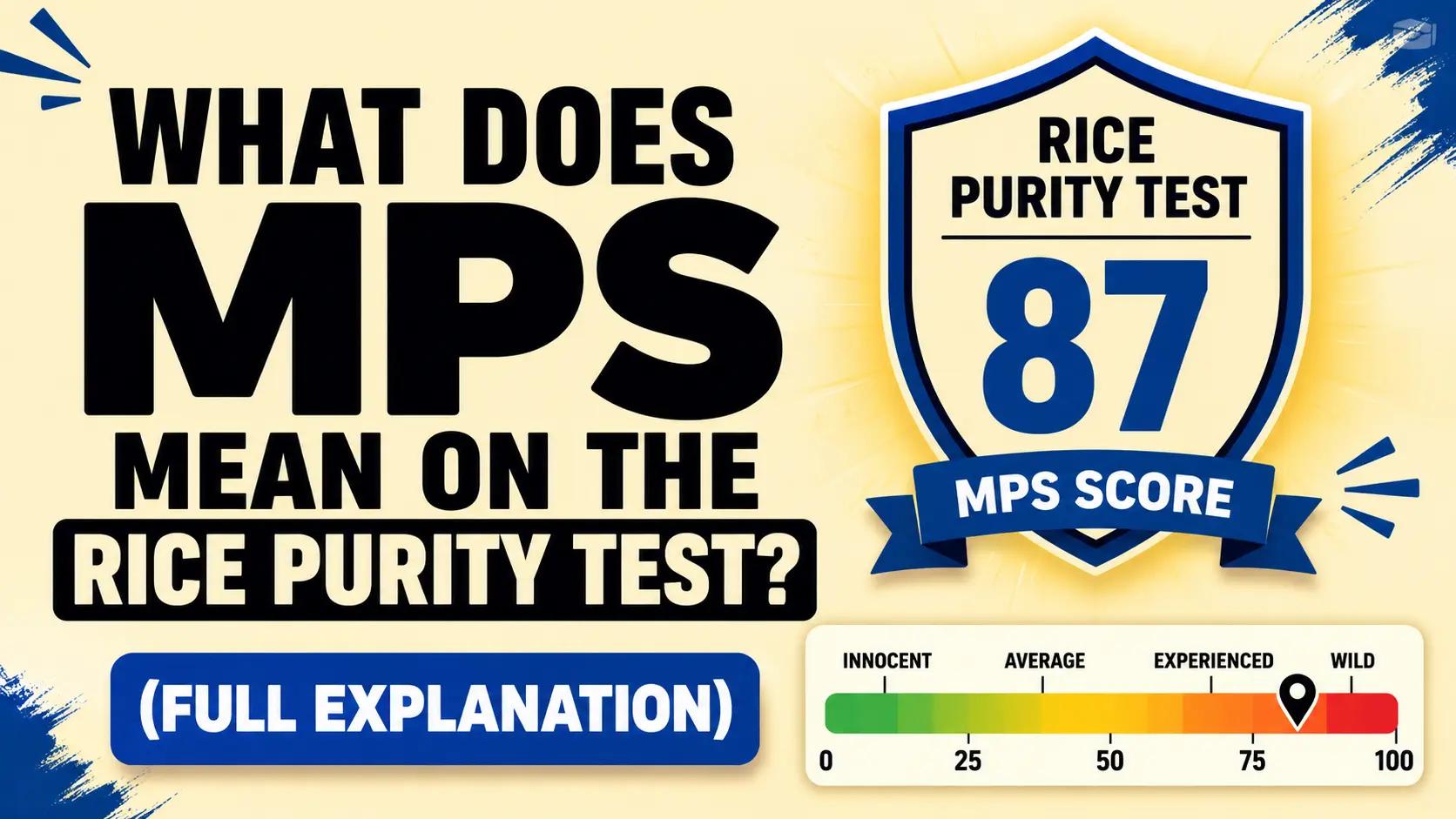
If you’re in the middle of the Rice Purity Test and just hit a question with “MPS” in it, here’s everything you need to know in plain language.
MPS Stands for “Member of Preferred Sex”
Break it down piece by piece:
- Member — one person
- of Preferred — that you’re attracted to or interested in
- Sex — the gender you’re attracted to
Put together, MPS just means: the gender or person you personally prefer. It’s a gender-neutral stand-in so the test works the same way no matter your sexual orientation.
- A straight man’s MPS is a woman.
- A gay woman’s MPS is a woman.
- A bisexual person’s MPS is whoever they’re attracted to in that moment.
- A non-binary person’s MPS is whoever they’re romantically or sexually interested in.
Nobody has to mentally rewrite the question based on who they’re attracted to. MPS already does that work for you.
Why the Test Uses “MPS” Instead of Just Saying “Partner”
This trips a lot of people up, so it’s worth explaining.
The Rice Purity Test was originally written for one group of students and later expanded to be inclusive of everyone, regardless of orientation. Instead of writing separate versions of every question for straight, gay, and bisexual test-takers, the test’s creators used one abbreviation, MPS, that automatically applies to whoever you’re attracted to.
Words like “partner” imply a committed relationship, which not every question is asking about. “Person” is too vague and loses the romantic angle entirely. MPS keeps that romantic or sexual context while staying gender-neutral. It’s an old piece of test shorthand that’s stuck around for decades, which is exactly why so many people pause and search for it today.
How to Answer Any MPS Question
There’s really one trick, and it works every time.
Replace “MPS” with “someone I’m attracted to” and reread the question.
Then ask yourself honestly: has this happened with someone you were romantically or physically interested in? If yes, check the box. If no, leave it blank.
A few common situations:
- You’re LGBTQ+: MPS works exactly the same way. Just picture whoever you’re attracted to. The question doesn’t change based on orientation.
- You’ve never had a romantic or physical experience with someone you’re attracted to: Then the answer to every MPS question is simply no. Nothing more to figure out.
- You’re not sure if something “counts”: If you’re genuinely unsure, it almost always means it didn’t happen the way the question describes. Answer based on your first honest instinct. This test isn’t a legal document, and there’s no wrong answer.
Once you’ve worked through every question, your final number is explained in detail in our guide to what your Rice Purity score actually means.
Other Confusing Terms on the Rice Purity Test
MPS isn’t the only piece of test language that makes people stop mid-quiz. Here are other terms people frequently get stuck on:
| Term | What It Means |
|---|---|
| Hickey | A mark left on the skin (usually the neck) from kissing or sucking hard enough to break small blood vessels under the skin. |
| French kiss | A kiss where both people’s tongues touch, more intimate than a closed-mouth kiss. |
| Streaking | Running through a public or semi-public space completely nude, usually as a dare or spontaneous act. |
| Skinny-dipping | Swimming without clothes, typically somewhere more private like a pool or lake. |
| Mile high club | Slang for having had sex on an airplane during a flight. |
| Mooning | Briefly exposing your bare backside to others, usually as a joke. |
| Booty call | Reaching out to someone specifically to arrange a casual sexual encounter, outside of a committed relationship. |
If a term still feels unclear after reading the definition, the simplest rule applies: if you genuinely don’t know whether you’ve done it, you probably haven’t, at least not in the way the question means it. Mark it no and move on. For a full breakdown of every question on the test, check our guide to what each Rice Purity Test question really means.
Frequently Asked Questions
MPS stands for Member of Preferred Sex, the person you’re romantically or sexually attracted to.
Neither one specifically, and both depending on who you’re attracted to. MPS refers to whichever gender you personally prefer. It isn’t fixed to one gender.
The same thing it means for everyone. A gay man’s MPS is a man, a lesbian’s MPS is a woman, and a bisexual person’s MPS is whoever they’re attracted to. The term was designed to work without needing any adjustment based on orientation.
Yes, on nearly every version. A small number of modern, rewritten versions of the test replace “MPS” with plainer phrasing like “someone you’re attracted to,” but the meaning stays identical. Only the wording changes.
Then the honest answer to every question that mentions MPS is no. That’s a completely normal result and reflects exactly where you are right now, nothing more to interpret.
Curious what your score actually means once you’ve finished? Check out our complete guide to what your Rice Purity score says about you, see the average Rice Purity score in the USA, or head back and take the test.
