
Rice Purity Score Meaning: What Every Score from 0 to 100 Really Says
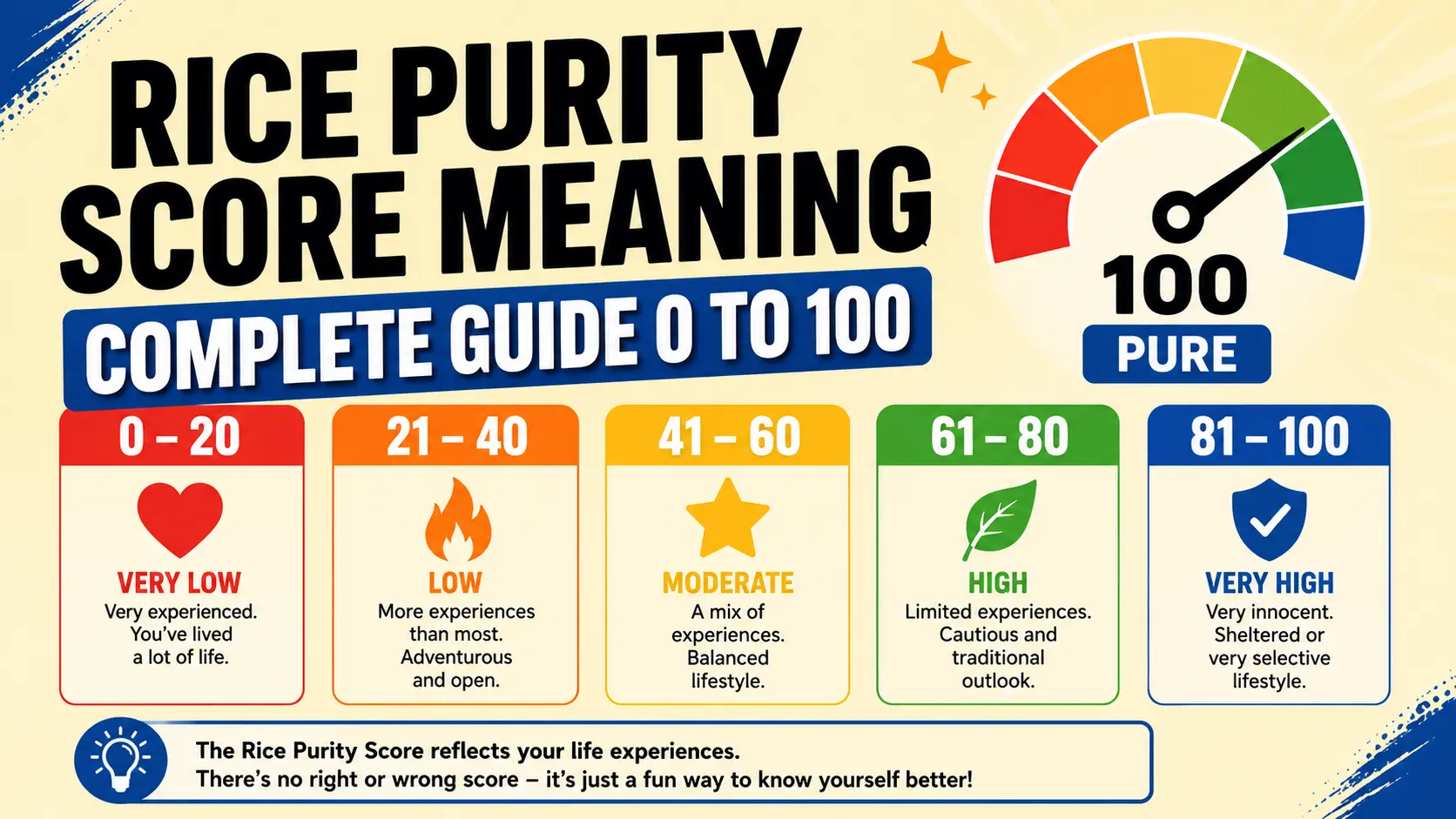
Quick Answer: The Rice Purity Score is a number between 0 and 100 generated by a 100-question self-report quiz. Higher scores (closer to 100) indicate fewer checked experiences; lower scores (closer to 0) indicate more. The average score for most adults falls between 60 and 65. Scores are not moral judgments — they simply reflect which experiences from the list a person has had.
If you just finished the Rice Purity Test and want to know what your result actually means — or if you’re trying to understand the score ranges, country averages, or what MPS stands for — this guide covers everything in plain language.
What Is the Rice Purity Score?
The Rice Purity Score is a number from 0 to 100 that comes from a self-administered, 100-question quiz. Each question asks whether you have experienced a specific activity. For every question you check “yes,” one point is subtracted from a starting score of 100. The result is your Rice Purity Score.
The test originated at Rice University in Houston, Texas, where it was used informally among incoming students as a way to bond and compare life experiences. It was never intended as a scientific measure — it was a conversation starter. Over time it spread online and became a widely shared social quiz, particularly popular among college students and young adults.
Key Takeaway: A score of 100 means none of the 100 questions were checked. A score of 0 means all 100 were checked. Most people score somewhere in between, with the global average hovering around 60–65 for adults.
The questions cover a range of life domains including romantic and sexual experiences, substance use, social behavior, and other adult situations. The test does not measure intelligence, morality, character, or maturity. It is simply a tally of self-reported experiences from a fixed list.
How Is the Rice Purity Score Calculated?
The calculation is intentionally simple:
- You start with a score of 100.
- You go through the list of 100 questions.
- For each question you answer “yes” (checking the box), 1 point is subtracted.
- Your final score = 100 minus the number of boxes you checked.
For example, if you checked 35 questions, your score is 65. If you checked 72 questions, your score is 28. There are no weighted questions — every item counts equally.
Some questions use the term MPS (Member of Preferred Sex) — here’s exactly what that means.
Rice Purity Score Ranges: What Each Range Means
While the Rice Purity Test produces a single number, that number is best understood in context of score ranges. The table below breaks down what each band generally reflects, based on the types of questions included in the test.
| Score Range | Label | What It Generally Reflects |
|---|---|---|
| 98–100 | Very Limited Experience | Almost no boxes checked. Common in young teenagers or those with very sheltered upbringings. Fewer than 3 experiences from the full list. |
| 80–97 | Light Experience | Primarily early social and mild romantic experiences. Hand-holding, first crush, light social exposure. Typical for mid-teens. |
| 60–79 | Average Range | A mix of social, romantic, and lifestyle experiences. The most common range for college students and young adults in their early 20s. |
| 40–59 | More Experienced | Broader life exposure across multiple categories. Common in adults with diverse social histories and varied life circumstances. |
| 20–39 | Highly Experienced | A significant number of list items checked. Reflects extensive social, romantic, and lifestyle exposure across many of the test’s categories. |
| 0–19 | Extremely Experienced | Almost all questions checked. The vast majority of the list’s experiences have been had. Very rare at the lower end of this range. |
Important Note: These ranges are descriptive, not prescriptive. A score in the 20–39 range does not mean someone is reckless; a score of 95 does not mean someone is superior. The test reflects exposure to a specific, culturally-situated list of experiences — nothing more.
What Does MPS Mean on the Rice Purity Test?
MPS stands for Mean Purity Score. It is the statistical average of Rice Purity Test scores collected from a defined group of users — typically visitors to a specific website or members of an online community.
When a platform reports an MPS, it means they have averaged the scores of everyone who has taken the test through their site. For example:
- If a site’s MPS is 63, the average user scored 63 out of 100.
- A personal score above the MPS means fewer checked experiences than the average.
- A personal score below the MPS means more checked experiences than the average.
MPS is not a universal benchmark. Different websites attract different audiences — a platform popular with college students will have a lower MPS than one that skews toward teenagers. Age, country, and community type all affect what the MPS will be for any given group. Treat it as a rough point of context, not a gold standard.
Average Rice Purity Score by Age Group
Life experience naturally increases with age, which is clearly reflected in Rice Purity Score trends across age groups. Younger users consistently report higher scores; older users report lower ones. The estimates below are based on community-reported averages and online score aggregation trends observed across multiple platforms.
| Age Group | Estimated Average Score | Typical Life Stage Context |
|---|---|---|
| 13–15 | 88–95 | Early adolescence; minimal romantic or adult experience |
| 16–18 | 75–87 | Mid-teens; early social and mild romantic milestones |
| 19–21 | 60–74 | College years; broader social, romantic, and lifestyle exposure |
| 22–25 | 50–65 | Early adulthood; moderate exposure across multiple categories |
| 26–30 | 40–55 | Mid-adulthood; wider relationship and lifestyle history |
| 31+ | 30–50 | Established adults; broad life experience reflected in score |
A high score at an older age is entirely normal and does not indicate immaturity. A lower score in a younger person similarly reflects lifestyle rather than character. Individual variation within any age group is wide — cultural background, upbringing, religion, and personal values all significantly influence where someone lands.
Average Rice Purity Score by Country
Cultural norms, family structures, religious influence, and social expectations shape life experience differently across the world — and this is clearly visible in Rice Purity Score patterns by country. Societies with more conservative social frameworks tend to produce higher average scores; societies with more liberal norms tend toward lower averages.
The estimates below reflect general patterns from community-reported data and regional user trends. There is no official global Rice Purity database, so these should be treated as directional benchmarks rather than precise statistics.
| Country | Estimated Average Score | Contributing Cultural Factors |
|---|---|---|
| Pakistan | 78–88 | Strong religious and family conservatism; limited pre-marital social mixing |
| Bangladesh | 76–86 | Similar South Asian conservative norms; cultural and religious modesty |
| China | 70–78 | Collectivist family values; social restraint common before marriage |
| India | 72–82 | Diverse but generally conservative; strong family oversight of relationships |
| United Arab Emirates | 74–84 | Islamic cultural framework; strict social norms, especially for women |
| Japan | 68–76 | Culturally reserved; lower dating frequency compared to Western averages |
| South Korea | 66–74 | Social conservatism mixed with Westernization; high educational focus |
| Mexico | 58–66 | Mixed cultural influence; urban vs. rural variation is large |
| South Africa | 57–65 | Diverse population; moderate average across urban communities |
| Canada | 62–68 | Liberal social norms; slightly higher than US average |
| United States | 60–65 | College-culture influence; broad social exposure by young adulthood |
| United Kingdom | 58–64 | Similar to US social trends; strong drinking and social culture |
| Italy | 56–64 | Family-oriented but socially expressive; moderate range |
| Spain | 54–62 | Open social culture; nightlife and social mixing common from young age |
| Australia | 55–63 | Outgoing social culture; lower average reflects broad early exposure |
| Brazil | 52–60 | Culturally expressive; relatively open social and romantic norms |
| Germany | 52–60 | Liberal and direct culture; low social stigma around adult experiences |
| France | 50–58 | Among the lowest Western averages; highly liberal social attitudes |
| Netherlands | 50–57 | Extremely liberal social norms; among the lowest reported European averages |
| Sweden | 48–56 | Progressive social culture; among the lowest average scores globally |
Cross-country comparison is useful for understanding cultural context but should never be used to judge individuals. A person from Sweden with a score of 85 and a person from Pakistan with a score of 85 have taken the same test but live within vastly different social frameworks. The number carries meaning only within its context.
What Is the Average Rice Purity Score in the USA?
In the United States, the average Rice Purity Score for adults falls between 60 and 65. This is largely driven by college-age users, who are the most active demographic taking the test online. High school students typically score higher (75–87), while adults in their late 20s and beyond often score lower (40–55).
Geographic variation within the US also exists. Students from urban, coastal universities tend to report lower scores than those from smaller, rural, or religiously-affiliated schools — a reflection of different campus cultures and local social norms.
Does Your Rice Purity Score Matter?
In a practical sense, no. The Rice Purity Test carries no official weight. It was created as an informal social exercise, not an assessment tool. No employer, institution, or authority uses it to evaluate anyone.
Where the score does carry some value is as a personal reflection tool. Many people find it useful for:
- Comparing experiences with friends in a lighthearted way
- Starting conversations about life milestones
- Reflecting on how their experiences have changed over time
- Connecting with peers during college orientations or social events
The most important thing to understand is that your score does not define you. A score of 14 and a score of 94 are equally valid reflections of different lives lived differently. There is no direction the score is “supposed” to go.
Should You Compare Your Rice Purity Score With Others?
Comparing scores can be fun and is part of why the test became popular in the first place. But there are a few things worth keeping in mind before you do:
- Cultural context matters. Someone raised in a conservative household will score differently than someone raised with few social restrictions — and both are valid outcomes of different environments.
- The list is fixed; life is not. The test only captures a specific set of experiences. There are countless meaningful life events it doesn’t measure at all.
- Peer pressure cuts both ways. Some feel pressure to have a lower score (seeming “experienced”); others feel pressure to have a higher one (seeming “pure”). Both are social pressures worth resisting.
Compare if you enjoy it. But don’t let the comparison assign value to your experiences that wasn’t there before.
Common Score Questions Answered
Is 70 a Good Rice Purity Score?
A score of 70 falls within the average range (60–79) and is extremely common, particularly among college students and young adults. It suggests a balance of social experiences — neither unusually sheltered nor unusually broad. There is nothing negative or positive about a score of 70.
Is 50 a Bad Rice Purity Score?
No. A score of 50 falls in the more experienced range (40–59) and is well within the typical range for adults in their mid-to-late 20s. It means roughly half the list’s experiences have been had. Whether that’s considered “a lot” or “a little” depends entirely on who’s asking and what cultural framework they’re applying.
What Does a 0 Rice Purity Score Mean?
A score of 0 means every single question on the test was checked — all 100 experiences from the list. This is extremely rare in practice. A genuine score of 0 would indicate someone who has had experience with literally every activity listed, including several that are extremely uncommon.
What Does a 100 Rice Purity Score Mean?
A score of 100 means no questions were checked — zero items from the 100-question list apply. This is most common in young adolescents or individuals who have had very limited social exposure. It is not a badge of honor or a point of shame; it simply reflects a specific life stage or lifestyle.
Related Rice Purity Score Guides
- Is 70 a Good Rice Purity Score? Full Context Explained
- Is 50 a Bad Rice Purity Score? What It Really Means
- What Does a 0 Rice Purity Score Mean? The Full Breakdown
Frequently Asked Question
A score of 100 means none of the 100 questions were checked, indicating the person has had no experience with the activities on the list. This is most common in young teenagers or those with very sheltered upbringings.
The average Rice Purity Score for most adults is between 60 and 65. College-age users (19–21) typically average 60–74. Scores naturally decrease with age as life experience increases.
Neither is better. The test is not a moral or character assessment. A high score means fewer experiences from the list were checked; a low score means more. Both are simply reflections of different lived experiences.
MPS stands for Mean Purity Score — the average score from a group of test-takers on a given platform. If a site’s MPS is 63, the average participant scored 63 out of 100. MPS varies by platform, age group, and region.
No. The Rice Purity Test is an informal, self-reported quiz created at Rice University for entertainment and social bonding. It has no psychological or medical basis and does not measure maturity, character, or health.
Scores vary by country because cultural norms, religious practices, family values, and social expectations differ significantly across regions. Countries with conservative social norms — like Pakistan, India, and China — tend to report higher average scores, while Western European countries tend toward lower averages.
A score of 50 falls in the “more experienced” range (40–59), suggesting roughly half of the test’s 100 questions were checked. This is common among adults in their mid-20s and reflects a broad range of social and lifestyle experience — not anything negative.
A score of 0 means all 100 questions were checked. This is extremely rare and would indicate experience with every activity on the full list.
Final Takeaway
The Rice Purity Score is a simple self-reflection tool with a misleadingly weighted name. The word “purity” implies judgment, but the test itself doesn’t deliver any. It returns exactly what you put in: a count of your self-reported experiences from a fixed list of 100 items.
Whether your score is 14, 67, or 99, the number reflects a snapshot of your life up to this point — shaped by your culture, upbringing, choices, and circumstances. No score is the right score. No direction is the correct direction.
Use it as a conversation starter, a moment of personal reflection, or a curiosity-driven comparison with friends. Just don’t use it to define yourself or evaluate anyone else.
Take the full Rice Purity Test here:
Rice Purity Test Online — Calculate Your Score Instantly
