
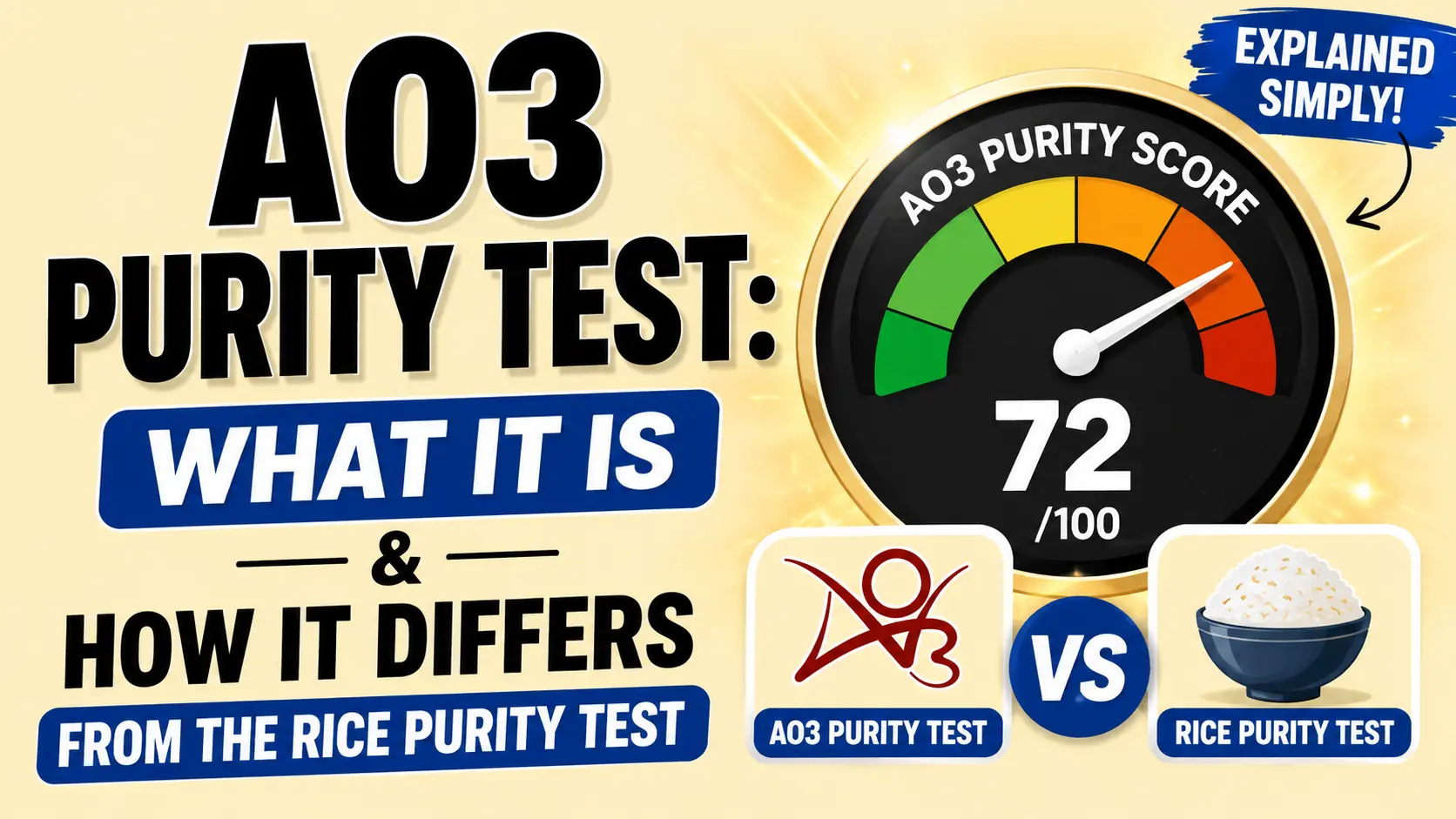
Quick answer: The AO3 Purity Test is a fan-made spinoff of the Rice Purity Test, built specifically for readers and writers on Archive of Our Own (AO3). Instead of measuring general life experience, it measures your exposure to fandom activity — reading habits, writing and creation, community engagement, content preferences, and platform usage. It uses the same scoring format as the original (start at 100, subtract a point for every box you check), but it isn’t affiliated with Archive of Our Own the organization, and it isn’t the original Rice Purity Test — it’s a community-built theme built on top of that format. If you just want your score, you can take the AO3 Purity Test here — this guide is the comparison.
If you’ve seen “AO3 purity test” trending on TikTok or Reddit and want to know whether it’s the same thing as the Rice Purity Test everyone talks about, the short version is: same scoring system, completely different questions. This guide breaks down exactly what it covers, how it compares category by category to the original, whether it’s “official” in any sense, and which one is actually worth taking first.
What the AO3 Purity Test Measures
The AO3 Purity Test is a themed variation of the Rice Purity Test built for the fanfiction and fandom community, named after Archive of Our Own — the largest fanfiction hosting platform in the world, home to more than 17 million works across over 77,000 fandoms. Rather than asking about romance, substances, or run-ins with the law, it replaces every question with something specific to fandom culture: what you’ve read, what you’ve written, how deep you’ve gone into tagging and commenting, and how far your content preferences stretch.
It follows the exact structural template that made the original test shareable in the first place — a long checklist, a simple point-per-item deduction, and a single score at the end that people compare with friends. That’s not a coincidence. The AO3 version exists because fandom communities recognized the format worked well as an icebreaker and rebuilt it around their own subculture instead of inventing something new.
Is the AO3 Purity Test Official?
No — and neither is the original. This is a detail most articles about the AO3 test skip entirely: the Rice Purity Test itself was never an official Rice University product either. It started as a student newspaper feature and spread because people kept copying and reworking it, not because any institution maintains or endorses it. The AO3 Purity Test follows that exact same pattern one layer further downstream. It’s a community-created checklist inspired by AO3 culture, hosted on independent fan sites and quiz platforms, with no connection to the Organization for Transformative Works, which actually runs Archive of Our Own.
In other words: both tests are grassroots, both spread because people found them fun to compare, and neither one is administered or verified by the organization it’s named after.
AO3 Purity Test vs. Rice Purity Test: Full Comparison
| Category | Rice Purity Test | AO3 Purity Test |
|---|---|---|
| What it measures | Real-life experiences: romance, physical intimacy, substances, legal encounters, social situations | Fandom experience: reading habits, writing & creation, community engagement, content preferences, platform usage |
| Origin | Rice University student newspaper; a short purity survey first ran in The Rice Thresher in 1924, expanded over later decades | Fan-made spinoff, popularized through TikTok and fandom Reddit/Discord communities |
| Scoring system | Starts at 100, minus 1 point per checked item | Same format — starts at 100, minus 1 point per checked item |
| Question count | 100 (standard version) | 100 items, grouped into 5 fandom-specific sectionss |
| Audience | General — students, young adults, anyone comparing life experiences | Niche — fanfiction readers/writers, primarily AO3 and fandom-space users |
| Official affiliation | None (not run by Rice University) | None (not run by Archive of Our Own / the OTW) |
| Score interpretation | Reflects general life exposure — widely benchmarked (the median across submissions on this site sits around 76) | Reflects fandom involvement depth — no widely agreed benchmark average exists |
What the AO3 Version Asks About Instead
Most versions of the AO3 test organize their checklist into roughly five sections, mirroring the structure of the original test but swapping the subject matter entirely:
- Reading habits — how widely and how deeply you’ve read across genres, ratings, and warning tags
- Writing & creation — whether you’ve published, co-written, or created transformative works of your own
- Community engagement — commenting, leaving kudos, joining fandom events, participating in discussions
- Content preferences — how far your tolerance stretches across tropes, pairings, and darker or more niche themes
- Platform usage — how familiar you are with AO3’s tagging system, bookmarking, and site mechanics
Our version runs all 100 items with a subscore for each of those five categories, so you get a breakdown rather than a single number. Take the AO3 Purity Test to see yours.
A lower score signals someone who’s been deep in fandom spaces for a long time; a higher score signals a newer or more casual reader. That’s structurally identical to how the original Rice Purity Test works — just pointed at a completely different subject.
Which One Should You Take First?
Take the AO3 version first if you actually read or write fanfiction — the questions will land, and the result is more interesting when you recognize what it’s asking about. Take the original first if you want a score you can compare against a large general population. A few things the original still does better as a benchmark:
- It has a real, comparable average. Because millions of people across the world have taken the standard Rice Purity Test, there’s a genuine global average to measure yourself against — something the AO3 version has no equivalent for yet, though our own statistics will build one as submissions accumulate.
- It’s not locked to one subculture. You don’t need to be active on AO3 or know fandom terminology to take it — anyone can complete it and get a result that means something.
- Full transparency on how scores are calculated. Our Rice Purity Score meaning guide breaks down every score range in plain language, something most fandom-spinoff sites don’t bother explaining at all.
- Live, real data — not guesswork. Our live Rice Purity Test statistics page shows the current average score calculated from real, anonymous submissions on this site, updated continuously rather than quoting a single old survey from years ago.
- Anonymous by default. No accounts, no email, no personal details. Scores are counted anonymously in aggregate so the statistics stay current, and nothing stored can be traced back to a person.
They answer different questions, so most people end up taking both. The original gives you a number you can compare widely; the AO3 version gives you one that means something to the people you’d actually share it with.
Can I Compare an AO3 Score to a Rice Purity Score?
Not directly, and this is a common point of confusion. The two tests measure completely different things using the same 0–100 scale, which makes them look comparable when they aren’t. A 65 on the AO3 test tells you about fandom involvement. A 65 on the standard test tells you about general life experience. Treat them as two separate scores measuring two separate parts of a person’s life — not different versions of the same number.
Frequently Asked Questions
It’s a fan-made checklist quiz built for the fanfiction community, using the same 100-point scoring format as the Rice Purity Test but replacing every question with fandom-related activities — reading habits, writing, community engagement, and content preferences.
No. It has no official connection to Archive of Our Own or the Organization for Transformative Works. It’s an independently created spinoff, the same way the original Rice Purity Test has no official affiliation with Rice University today.
The same way as the original: you start at 100 points, and each activity you check off subtracts one point. A lower final score means more fandom activity; a higher score means less.
The Rice Purity Test measures general real-life experiences across romance, substances, legal encounters, and social situations. The AO3 Purity Test uses the identical scoring format but measures fandom-specific activity instead — what you’ve read, written, and engaged with in fanfiction spaces.
If you read or write fanfiction, start with the AO3 version — the questions will mean more to you and the result is more fun to share. If you want a score benchmarked against a large general population, start with the standard Rice Purity Test, which has a verifiable average behind it.
On this site. It runs all 100 items with a subscore for each of the five fandom categories, free and anonymous with no sign-up.
Take Either Test
Ready for your fandom score? Take the AO3 Purity Test — 100 questions across five categories, free and anonymous with no sign-up.
Or take the full Rice Purity Test for the original, then check the live statistics page to see how your score compares to everyone else who has taken it.
