
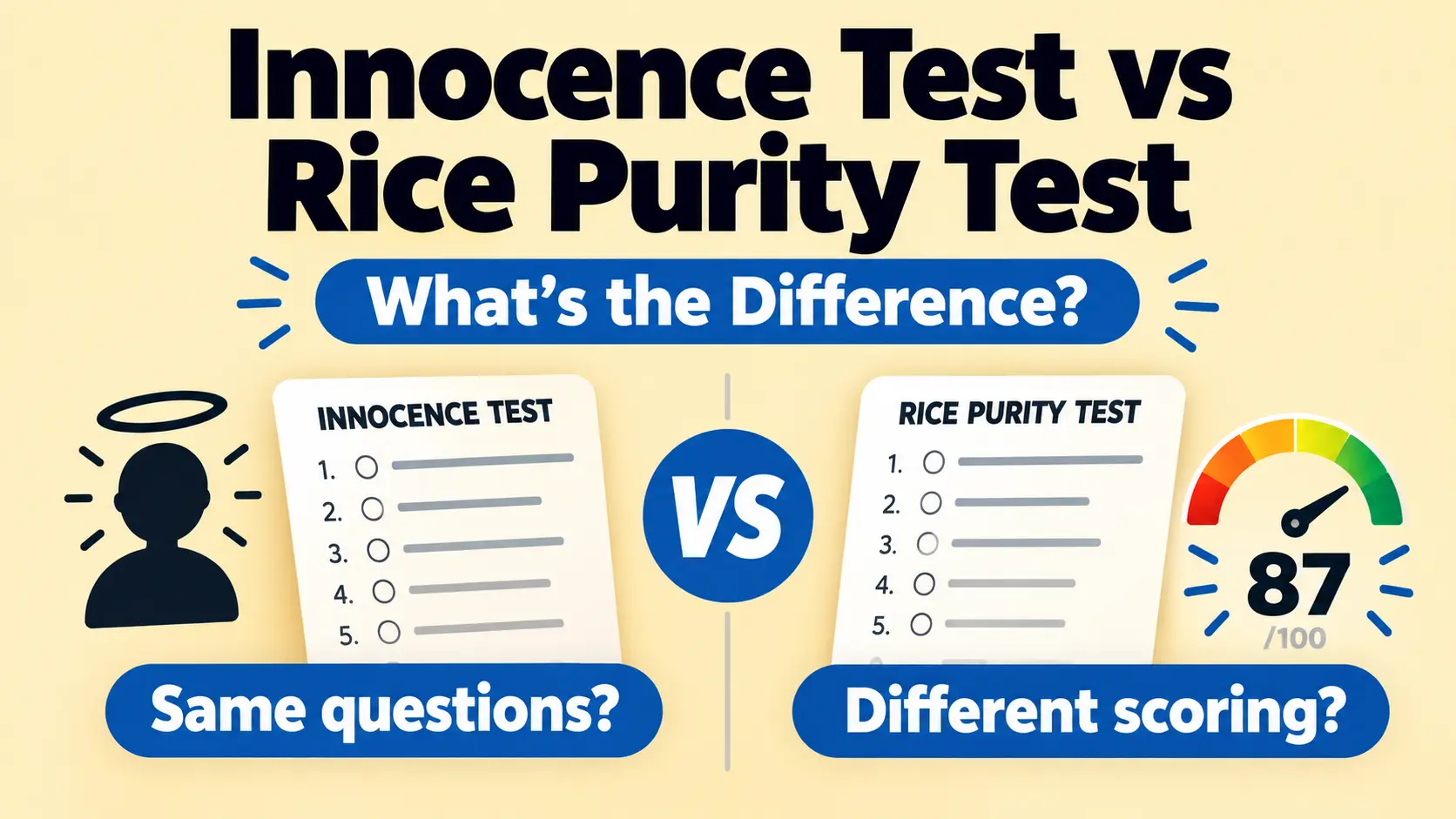
If you have taken both and got different numbers, you probably did not take two different tests. You most likely took two versions of the same one — and the difference between them matters more than the name.
Quick Answer: “Innocence test” is most often an alternate name for the Rice Purity Test, using the same 100-question checklist and the same scoring. Some versions differ, though — the question count varies and a few reverse the scoring direction, so a high number means more experience rather than less. Always check which direction a version scores before comparing results.
Are They the Same Test?
Definition: The Rice Purity Test is a specific 100-item checklist that originated at Rice University. “Innocence test” is a generic descriptor that most sites apply to the same checklist, and a few apply to their own variants.
In the common case, they are the same thing under two names. Sites rebrand it for a few reasons: “purity” reads as moralistic to some audiences, “innocence” sounds softer, and a generic name avoids implying any connection to a university.
What this means: If a site calls it an innocence test and gives you 100 questions scored down from 100, you took the Rice Purity Test. Our page on why it is called the Rice Purity Test covers where the original name comes from.
What to Compare Before You Compare Scores
Three things vary between versions. Check them before treating two numbers as comparable:
| What to Check | Why It Matters |
|---|---|
| Question count | The Rice Purity Test uses exactly 100 items. Shorter variants exist, and fewer questions compress the scale — the same person scores differently on a 50-item version. |
| Scoring direction | The standard test counts down from 100, so a lower score means more experience. Some innocence tests reverse this. Two people with identical histories can get opposite-looking numbers. |
| Question wording | Many sites soften or reword items. Since every item costs one point regardless of phrasing, different wording produces different totals for the same person. |
Insight: Scoring direction is the one that trips people up. If someone tells you they scored 20 on an innocence test, that could mean almost nothing applied to them or almost everything did, depending on which way the version counts.
How the Rice Purity Test Scores
People Also Ask: Does a high score mean more or less experience?
On the Rice Purity Test, less. You start at 100 and each checked item subtracts one point, so your score equals 100 minus the number of boxes you checked. A score of 90 means ten items applied to you.
This is the direction most people expect, but it is worth stating explicitly because reversed versions exist. Our breakdown of how the score is calculated walks through the arithmetic with a worked example.
Why the Same Person Gets Different Scores
Beyond scoring direction, several things produce gaps between versions:
- Item substitutions. Different versions swap questions in and out, so a person might check an item on one site that does not exist on another.
- Vague wording. Softened items get interpreted differently. Two people reading the same reworded question can answer it opposite ways.
- Pre-checked or extra rows. Some implementations include non-question rows in the count, which shifts every result by a point or more.
We cover this in more depth in why rice purity test sites give different scores.
Which One Should You Take?
If you want a number that is comparable to anyone else’s, take the standard 100-question version scored down from 100. That is the format with published data behind it and the one most people mean when they mention a score.
Neither version measures anything about you regardless. Both count checked boxes with no weighting for severity, timing, or context — see whether the test is accurate for why that limits what any score can mean.
Innocence Test vs Rice Purity Test: Myth vs Reality
| Common Belief | Reality |
|---|---|
| They are two completely different tests | Usually the same checklist under a different name, though variants do exist. |
| All innocence tests score the same way | Scoring direction varies. Some count up rather than down. |
| Every version has 100 questions | The Rice Purity Test does. Shorter variants circulate under the innocence-test name. |
| Scores transfer between versions | They do not. Different item counts and wording produce different totals for the same person. |
| A lower score always means more experience | Only on versions that count down from a starting total. Check the direction first. |
| One version is more accurate | Neither measures anything. Both count checked boxes with no weighting applied. |
Frequently Asked Questions
In most cases yes. “Innocence test” is commonly an alternate name for the same 100-question checklist, though some sites use it for their own shorter or differently scored variants.
It depends on the version. The Rice Purity Test uses exactly 100 questions, but variants circulating under the innocence-test name use different counts.
On versions that follow Rice Purity Test scoring, a higher score means less experience. Some versions reverse this, so check the direction before comparing.
Different versions use different question counts, different wording, and sometimes opposite scoring directions. None of those totals are directly comparable.
The standard 100-question version scored down from 100, if you want a result comparable to published figures and to other people’s scores.
No. Both count checked boxes without weighing severity, timing, or context, so neither can measure anything about a person.
It is a generic descriptor rather than an original title. Sites use it as a softer alternative to “purity,” which some audiences read as moralistic.
Take the standard 100-question version to get a score that actually compares to everyone else’s.
