
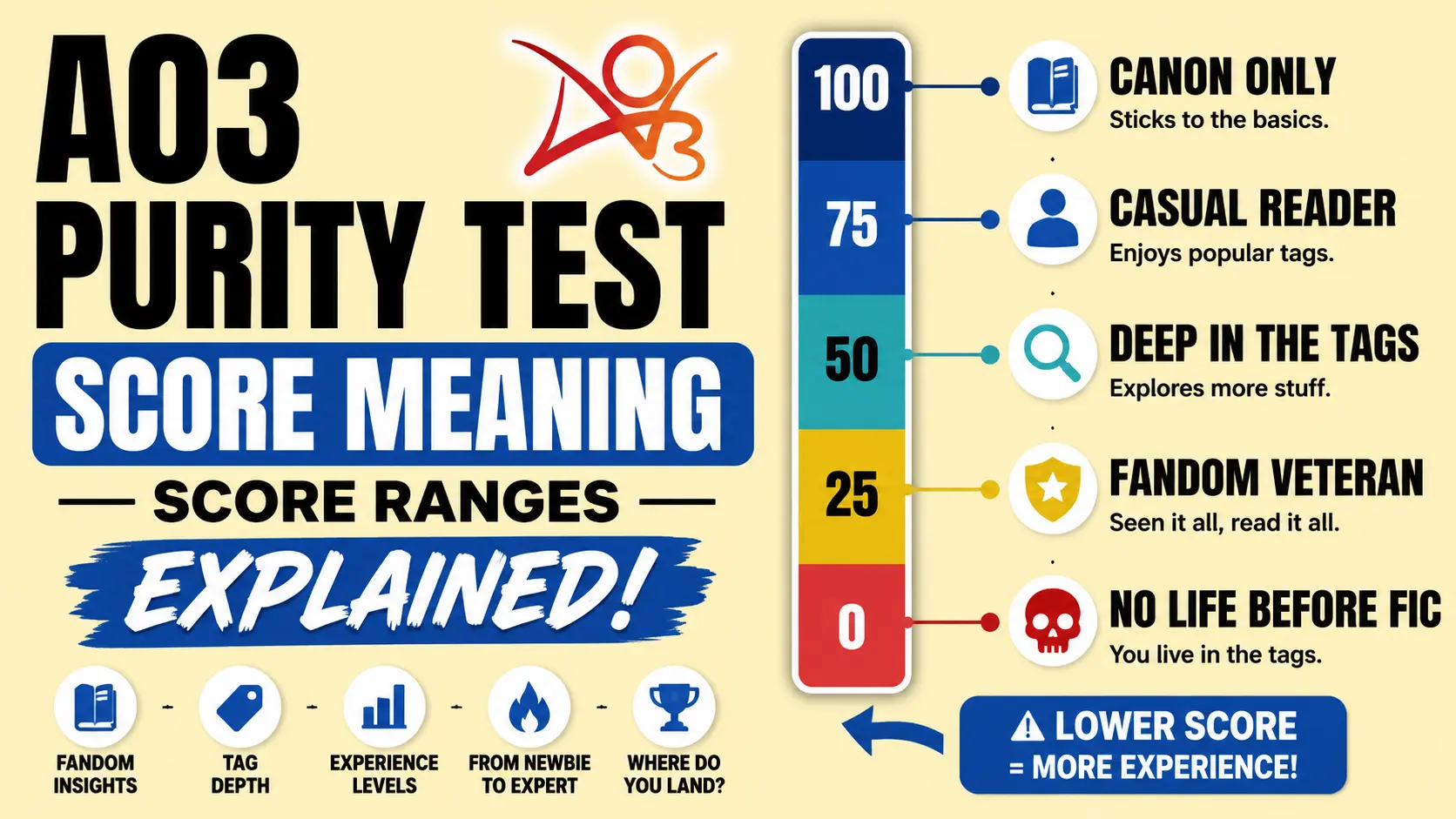
That inversion is the single most misread thing about this test, and it changes how every number below should be interpreted.
What Does Your AO3 Purity Test Score Mean?
The score is a count, not a grade. You start at 100 and lose one point for each of the 100 items you have done, so your number is simply 100 minus how many boxes you checked. There is no answer key and no weighting — leaving kudos on a fic costs the same single point as physically binding one into a book.
What the number tells you is breadth of exposure across one fixed list of fandom activities. It says nothing about taste, nothing about how much you enjoy fandom, and nothing about you as a person. Someone who has read two hundred fics in one pairing and never left a comment will score higher than someone who has skimmed twenty fics across ten fandoms and commented on all of them. Depth in one area and breadth across the list are different things, and only the second one moves your score.
AO3 Purity Test Score Ranges Explained
There is no official grading system, but scores cluster into five recognizable bands.
- 100 – 90 — Canon Only. You know fanfiction exists and may have read a little. Most of the archive’s habits, vocabulary, and mechanics are still unfamiliar. Almost everyone starts here, usually for about a week.
- 89 – 70 — Casual Reader. You read when a canon grabs you, mostly whatever sits on the first page sorted by kudos. You have probably never written anything, and the tagging system is something you use rather than something you have opinions about.
- 69 – 50 — Deep in the Tags. Filters are set. You have excluded tags you cannot stand, you have at least one bookmark you would not show anyone, and you have waited a long time for an update that never came. This is where most active fandom readers land.
- 49 – 30 — Fandom Veteran. Reading, writing, and community are all in play. You have posted something, abandoned something, and survived at least one discourse cycle. You know what tag wrangling is without having to look it up.
- 29 – 0 — No Life Before Fic. Rarepair tags cleared, exchanges signed up for and missed, EPUBs downloaded for flights. At this point fandom is not a hobby you have, it is a thing you are inside of.
Take the AO3 Purity Test if you have not yet — the ranges only mean something once you have a number to place in them.
What Is a Good AO3 Purity Test Score?
There is no good score, but there is a socially preferred direction, and it runs opposite to the original test.
In fandom spaces, a low AO3 score reads as fluency. It says you have been around, you know how the archive works, and you can be trusted to understand a reference. People post low scores the way you would post a long-service badge. A high score is not shameful — it usually just means you found fanfiction recently, which was true of everyone with a low score at some point.
If you are scoring yourself against anyone, score yourself against people in the same fandom spaces as you. Comparing your number to a stranger’s tells you almost nothing, because the two of you may not have overlapped on a single one of the hundred items.
What Does a 0 AO3 Purity Score Mean?
A 0 means every single item on the list applies to you: you have read, written, orphaned, podficced, beta-read, bookmarked, downloaded, bound, donated, and been through at least one fandom you now refuse to name. It is rare and mostly signals a decade or more of continuous involvement.
It is worth being skeptical of any 0 posted publicly. The test is self-scored with no verification, and the bottom of the range is exactly where people round down for the joke.
What Does a 100 AO3 Purity Score Mean?
A 100 means you checked nothing at all — you have never read fanfiction. This is genuinely uncommon among people who seek out the test in the first place, since finding it usually means you were already somewhere near fandom. If you scored 100, you are most likely here because someone sent it to you.
What Is the Average AO3 Purity Test Score?
Nobody knows, and any site publishing a specific average for the AO3 test is guessing.
This matters more than it sounds. The original Rice Purity Test has been taken by enough people, in a stable enough format, that a real distribution exists — we publish what each range means for the original based on actual submissions. The AO3 version has no equivalent. Its question sets vary wildly between sites, it is far newer, and the volume is a fraction of the original’s.
We will publish a real AO3 average once enough scores have come through this site’s version to make the number honest. Until then, the accurate answer is that there isn’t one, and treating a made-up figure as a benchmark will only make you misread your own result.
What Do the Category Subscores Mean?
A single number flattens five very different things. Our version splits the hundred items into five groups and scores each separately, which usually tells you more than the total.
- Reading (22 items) — how much and how far you have read: word counts, rereads, unfinished WIPs, 2am binges
- Writing and creation (22 items) — posting, orphaning, abandoned drafts, podfic, fanart
- Community (20 items) — kudos, comments, bookmarks, exchanges, servers, discourse
- Content and tags (20 items) — ratings, archive warnings, tropes, rarepairs, filtering habits
- Platform (16 items) — site skins, downloads, saved searches, tag wrangling knowledge
Because the groups have different item counts, compare them as percentages of their own maximum rather than raw points. The interesting results are the lopsided ones. High reading with near-zero writing is the classic lurker profile. High writing with low community means you post and disappear. High platform and content with moderate reading usually means someone who spends as much time filtering the archive as reading it.
Can You Compare an AO3 Score to a Rice Purity Score?
No. They share a scale and share nothing else.
The Rice Purity Test asks about your own life — relationships, substances, encounters with the law. The AO3 version asks about what you have read and written. A person can score 92 on one and 24 on the other with no contradiction whatsoever, because the two numbers describe unrelated parts of a life. We break the two down side by side in how the AO3 test differs from the Rice Purity Test.
The one thing they share is the direction problem in reverse: on the original, people often treat a low score as something to explain. Here, they compete for it.
Why Does the Same Person Get Different AO3 Scores on Different Sites?
Because there is no canonical question list. Different sites write their own items, merge some, split others, and vary the count. A single experience might cost you two points on one version and one on another, or not appear at all.
That means a score from one site is not comparable to a score from another, and a score you got a year ago on a different version is not comparable to today’s. This is the same problem the original test has, for the same reason — we looked at where those discrepancies come from in detail.
Should You Take Your Score Seriously?
Only as far as it is fun. The AO3 purity test is a fan-made checklist with no validation behind it, no research, and no organization standing behind the question list. It is not affiliated with Archive of Our Own or the Organization for Transformative Works, which runs the archive — a nonprofit that exited open beta in April with more than 17 million works across over 77,000 fandoms, and which has nothing to do with this quiz.
The number is a conversation starter. It works because comparing it with people who share your references is funny, and it stops working the moment anyone treats it as a measurement.
Frequently Asked Questions
It measures how much fandom activity you have done, from 100 down to 0. You start at 100 and lose one point per item you have experienced, so a lower score means more fanfiction reading, writing, and community involvement. A higher score means less.
Neither, but fandom treats low as impressive. A low score signals long involvement and familiarity with how the archive works. This is the reverse of how people usually read a low score on the original Rice Purity Test.
There is no good or bad score. If you are asking socially, most people in fandom spaces treat scores under 50 as a sign of experience. If you are asking objectively, the number reflects exposure and nothing else.
There is no verified average. The test is too new and its question sets vary too much between sites for a reliable figure to exist. Any specific average you see published is an estimate rather than measured data.
A 60 falls in the “deep in the tags” range. It usually describes an active reader with set filters, real preferences, and some community participation, but limited or no writing of their own.
It means every item on the list applies to you — reading, writing, community, tags, and platform mechanics all checked off. It generally indicates many years of continuous fandom involvement.
No. They use the same 0 to 100 scale but measure entirely different things. One is about your own life experiences, the other about what you have read and written.
Because there is no standard question list. Sites write their own items and vary the count, so the same person can score differently on two versions of the same test.
Whatever your number is, it is a record of what you have read and made. Screenshot it, post it, and go find out whose is lower.
