
If you landed here after seeing your score, you are probably asking whether the number is something to worry about. The short answer is no — but the data behind that answer is more interesting than the reassurance.
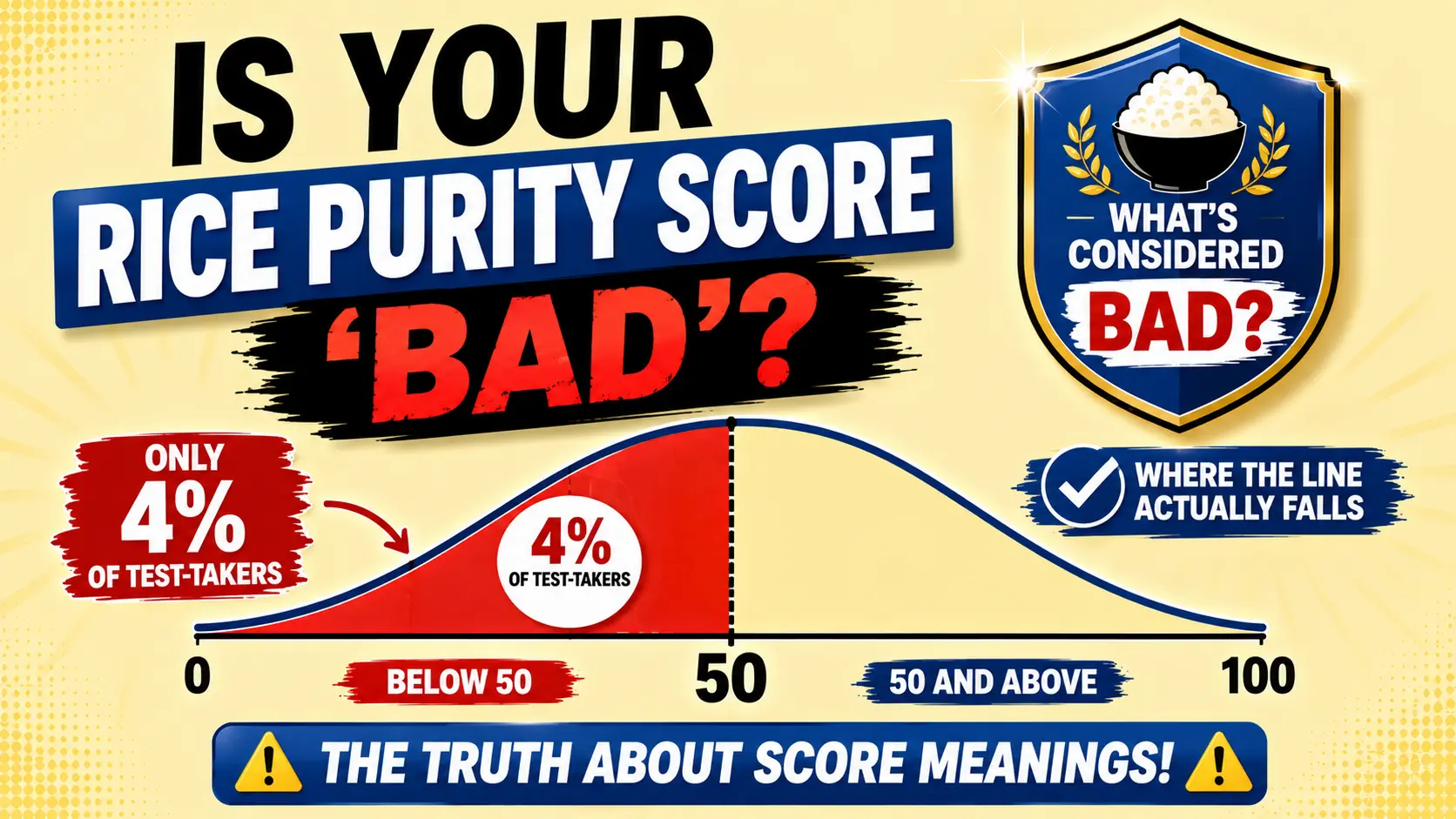
Quick Answer: There is no objectively bad rice purity score, because the test measures how many experiences you have had, not whether those experiences were good decisions. Statistically, scores below 50 are uncommon — only about 4% of the 125,000+ submissions on this site fall there. But uncommon is not the same as bad, and the test has no mechanism for judging anyone.
What People Usually Mean by a “Bad” Score
Definition: When people call a rice purity score “bad,” they almost always mean “lower than I expected” — not that the score indicates anything wrong. The confusion comes from the scoring direction: a lower number means more checked experiences, and people instinctively read a low number on a 0–100 scale as a failing grade.
It is not a grade. The test subtracts one point for each experience you have had, so your score is a count, not an assessment. Someone who scores 45 has simply checked 55 boxes. The test does not know or care what those boxes were.
What this means: The phrase “bad score” imports a judgment the test never makes. A more useful question is “how common is my score?” — and that has a real, data-backed answer.
Where Low Scores Actually Sit
Here is where every score range ranks against live submissions on this site, updated automatically as of August 2026:
| Score Range | Percentile Range | You Rank Above | What That Means |
|---|---|---|---|
| 90–100 | 90th–100th | 90%+ of test-takers | Top tier. Very few checked experiences compared to almost everyone. |
| 80–89 | 63rd–89th | 63–89% of test-takers | Well above average. A small handful of mild experiences. |
| 70–79 | 31st–62nd | 31–62% of test-takers | The most crowded band, holding 32.7% of submissions, contains both the median (76) and estimated average (74.21). |
| 60–69 | 11th–30th | 11–30% of test-takers | Broad experience across dating, drinking, and mild rule-breaking. |
| 50–59 | 4th–10th | 4–10% of test-takers | Below average. Less common than most people assume. |
| 26–49 | 1st–3rd | 1–3% of test-takers | Bottom tier. Extensive experience across most categories. |
| 0–25 | 0th–1st | Under 1% of test-takers | The rarest outcome on the test. |
Insight: The numbers people fear most are genuinely rare. Scores below 50 account for about 4% of all submissions combined, and scores below 26 account for well under 1%. Meanwhile the median score is 76, meaning half of all test-takers score above that.
This produces a strange effect worth naming. Because the distribution is so crowded at the high end, a score of 60 — which sounds respectable — actually ranks in the bottom third. That is not a sign that something is wrong with a 60. It is a sign that the scale and the population are not aligned, which is exactly why raw scores mislead people. Our rice purity score percentile breakdown covers this in detail.
Why the Score Measures Experience, Not Character
People Also Ask: Does a low rice purity score mean something is wrong with me?
No, and the structure of the test makes this clear once you look at it. Three flaws prevent the score from saying anything about character:
- Every item weighs the same. Holding hands and serious rule-breaking each subtract exactly one point. A score cannot distinguish between fifty mild experiences and fifty serious ones.
- It has no time axis. Someone who did everything on the list across fifteen years scores identically to someone who did it all in one year. Those are very different lives producing the same number.
- It has no context. The test does not ask whether an experience was wanted, regretted, safe, or meaningful. It only counts.
A measurement that cannot distinguish severity, timing, or context is not measuring character. It is measuring volume.
What Actually Drives a Low Score
Three factors explain most of the variation, and none of them are about who someone is:
- Age. Scores fall steadily from the mid-teens into the twenties simply because ordinary milestones accumulate. A 55 at twenty-four and an 80 at sixteen often describe the same person at different points.
- Environment. College and dorm life compresses years of firsts into a short window. This is why the average rice purity score shifts noticeably between student and non-student groups.
- Honesty. Some of the lowest scores on record are not real. People exaggerate in group settings, and the 0–25 band in particular contains a meaningful share of joke submissions — which is part of why a score of 0 should not be read literally.
Is There a Score You Should Worry About?
What this means: Not in the way the question implies. The score itself is never the concern.
What can matter is how you feel about the specific experiences behind it — and that has nothing to do with the number. Someone can score 85 and feel uneasy about one item on the list, while someone scoring 40 feels fine about all sixty. The test flattens that difference entirely, which is the clearest evidence that it is not a wellbeing measure.
If a particular experience is sitting badly with you, that is worth talking through with someone you trust. But no arithmetic on a hundred checkboxes will tell you anything useful about it.
Bad Score Myths vs Reality
| Common Belief | Reality |
|---|---|
| Anything under 50 is a bad score | Under 50 is uncommon — about 4% of submissions — but rarity is not a verdict. |
| A low score means poor judgment | Every item costs one point, so the score cannot distinguish mild from serious. |
| The average is around 50, so below that is bad | The median is 76 and the estimated average is around 74. Most guesses are far too low. |
| A bad score follows you | Nothing is stored or attached to you. Only anonymous final scores are recorded. |
| Scoring low means you are unusual | It means you took a test with a young, self-selected audience — not a representative sample. |
| A high score is the safe result | High scores get judged too. The test invites comparison in both directions, which is its real flaw. |
How to Read Your Own Score Properly
Three habits make the number far less loaded:
- Compare within your own age group, not against everyone. A 72 among college seniors and a 72 among high school sophomores are not the same result.
- Read the band, not the digit. A one-point difference is noise. See the full rice purity score chart for what each range actually indicates.
- Remember the sample. These figures come from people who chose to take an online purity test, which skews young and social-media-driven. They are not population statistics.
Frequently Asked Questions
There is no bad rice purity score. The test counts how many of 100 listed experiences you have had, and it applies no judgment to any of them. People usually call a score “bad” when it is lower than they expected, not because the number indicates a problem.
It is uncommon rather than bad. About 4% of the 125,000+ submissions on this site fall below 50, which makes it a rare result but not a negative one. Rarity and quality are different things.
Roughly 90% of test-takers score 60 or above, so scores below 60 are statistically uncommon on this site. That said, “normal” here only describes this audience, which skews young and self-selected.
No. The test weighs every item equally, ignores when experiences happened, and captures no context about them. A measurement that cannot tell mild from serious cannot say anything about character.
The median score on ricepuritytest.bz is approximately 76, meaning half of all submissions fall above it. The estimated average is around 74. Both are far higher than most people assume before seeing the data.
Not about the number itself. If a specific experience behind your score is bothering you, that is worth discussing with someone you trust — but the score is just a count and tells you nothing useful about it.
Scores only move downward over time, since each checked experience permanently subtracts a point. There is nothing to improve, because there is no target to reach.
Take the test to see your own score, then read it as what it is — a count of experiences, not a verdict on any of them.
