
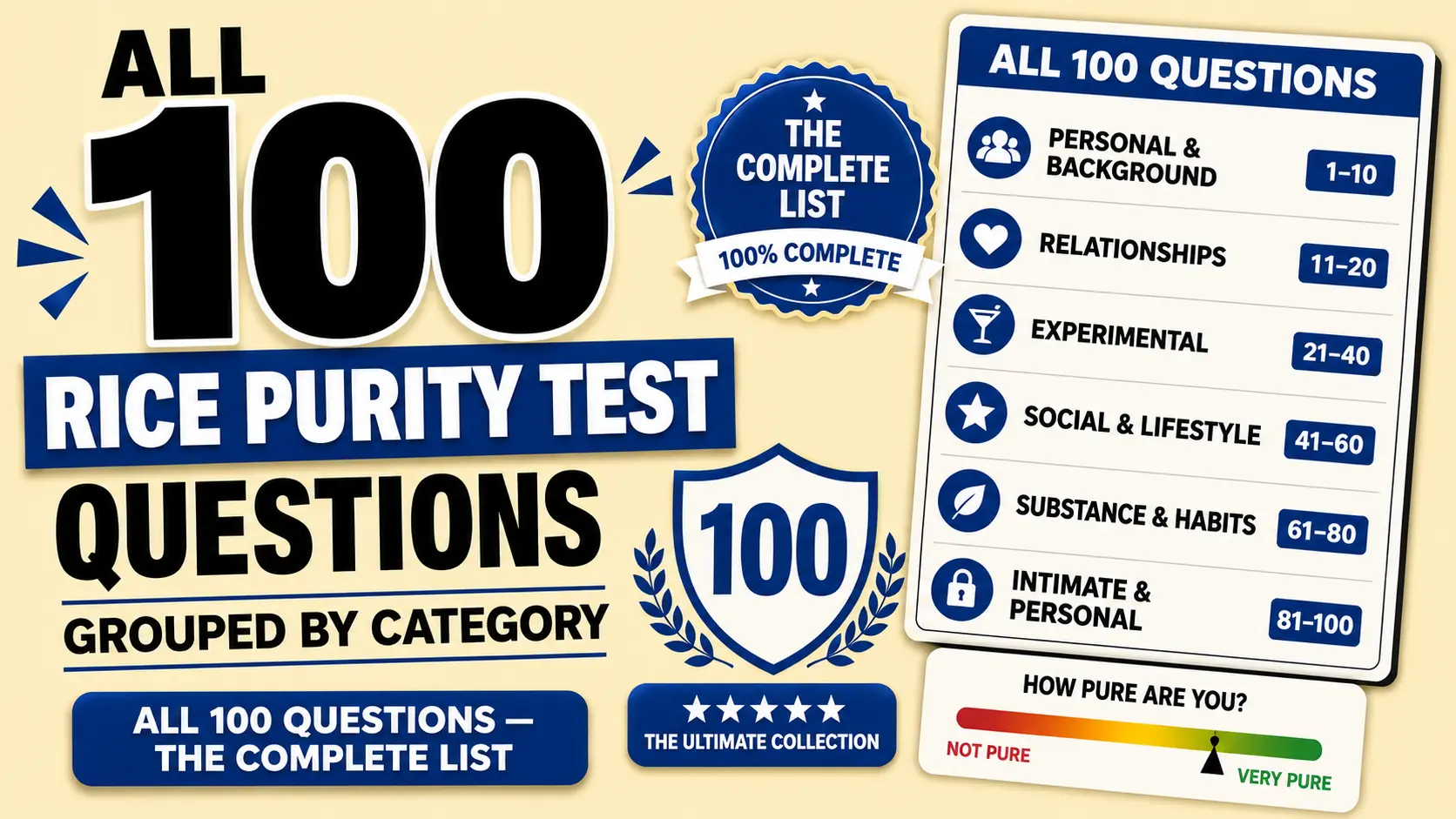
Most people take the Rice Purity Test without ever seeing the questions laid out in one place. Below is the complete list of all 100, numbered and grouped by category, exactly as they appear on the test.
Quick Answer: The Rice Purity Test contains exactly 100 questions covering dating, kissing, physical and sexual intimacy, substances, and rule-breaking. Each question you check subtracts one point from a starting score of 100, so your final score equals 100 minus the number of items that apply to you. There are no follow-up questions and no weighting — every item counts the same.
How the Questions Are Scored
Definition: The Rice Purity Test is a 100-item checklist where each checked box removes one point from a starting total of 100.
- The test presents 100 statements about life experiences, ordered roughly from mild to extreme.
- You check every statement that applies to you.
- Each checked box subtracts one point from a starting total of 100.
- Your final score equals 100 minus the number of boxes you checked.
Check 24 boxes and you score 76 — which happens to be the median result across submissions on this site. Check none and you score 100. For what each range indicates, see our complete rice purity score chart.
Questions 1–10: Dating and Romance
The opening section covers relationship milestones with no physical component at all — asking someone out, being in a relationship, breaking up. These are the items almost everyone checks, which is why scores above 95 are uncommon.
- Held hands with someone in a romantic way?
- Asked someone out, or been asked out?
- Gone out on a planned date with someone?
- Been in an exclusive relationship?
- Told a romantic partner you loved them?
- Danced closely with someone you liked?
- Been in a relationship lasting more than a year?
- Ended a relationship yourself?
- Been broken up with?
- Had feelings for someone who did not feel the same?
Questions 11–20: Kissing and Light Affection
Ten items covering first kisses through more sustained affection. This block is where most high scorers lose their first points, and it separates the 90s from the 100s more than any other section.
- Kissed someone outside your family?
- Shared a kiss on the lips?
- Had a passionate kiss?
- Kissed someone in a public place?
- Kissed someone on the neck?
- Spent a long time kissing continuously?
- Kissed someone while lying down together?
- Given or received a visible love bite?
- Kissed someone you had only just met?
- Kissed more than one person on the same day?
Questions 21–28: Solo Experiences and Adult Media
This block shifts from partnered experiences to solo ones. It is the section people most often assume they are alone in checking, when in practice these rank among the more commonly selected items on the entire test.
- Viewed adult-themed content?
- Explored your own body privately?
- Used media or imagination for personal stimulation?
- Had a private moment while someone else was in the room?
- Been walked in on during a private moment?
- Used an object or device for personal exploration?
- Viewed adult content on a shared or public device?
- Talked openly with friends about private habits?
Questions 29–34: Digital Intimacy
These six items did not exist in the original version of the test and are the fastest-changing part of the list, since the behaviors they describe depend on technology that keeps shifting.
- Sent a flirty or suggestive message?
- Sent a revealing photo of yourself?
- Received a revealing photo from someone?
- Engaged in intimate activity over a video call?
- Used a dating or hookup app?
- Met someone in person after meeting them online?
Questions 35–44: Physical Intimacy with a Partner
Partnered physical contact short of sexual activity. The progression here is deliberately gradual, which is one reason scores cluster into bands rather than spreading evenly across the scale.
- Played a game that involved removing clothing?
- Simulated intimacy while fully clothed?
- Given or received a full-body massage?
- Helped remove, or had someone remove, your clothing?
- Been fully undressed in front of a partner?
- Shared a shower or bath with someone?
- Experienced upper-body physical affection?
- Experienced more private physical contact?
- Felt strong physical attraction without fulfillment?
- Reached climax because of a partner?
Questions 45–56: Sexual Experience
The core sexual-experience items sit here. This is where the largest score differences between test-takers open up, and where the 70s band starts to separate from the 80s.
- Bought protection for safe intimacy?
- Stayed overnight with someone romantically?
- Asked a roommate or family member to leave for privacy?
- Performed oral intimacy?
- Received oral intimacy?
- Had full intimate relations with a partner?
- Had a partner who was your first?
- Been someone else’s first partner?
- Used an adult toy with a partner?
- Been interrupted during an intimate moment?
- Been intimate with someone shortly after meeting them?
- Been intimate with someone you were not in a relationship with?
Questions 57–72: Settings, Frequency, and Circumstances
The longest block on the test covers where, how often, and under what circumstances — rather than introducing new activities. It also contains question 69, which draws more attention than any other number on the list.
- Been intimate in a vehicle?
- Been intimate outdoors?
- Been intimate in water, such as a pool or hot tub?
- Been intimate in a semi-public place?
- Been intimate somewhere unfamiliar?
- Been intimate while other people were nearby?
- Been intimate while traveling by air?
- Traveled a long distance specifically for a partner?
- Arranged a casual late-night meetup?
- Had more than one intimate experience in a single day?
- Been intimate regularly over an extended period?
- Skipped protection during intimacy?
- Experienced mutual, simultaneous intimacy with a partner?
- Been with someone significantly older or younger than you?
- Been intimate with someone who was already in a relationship?
- Been unfaithful in a relationship?
Questions 73–82: Alcohol and Substances
Alcohol, tobacco, and drug items run consecutively through this block. This section tends to fill in sharply between ages 16 and 22, which is the single biggest driver of falling scores over time.
- Consumed alcohol socially?
- Participated in a drinking game?
- Been noticeably intoxicated?
- Pretended to be sober in front of authority figures?
- Forgotten events because of drinking?
- Tried smoking or tobacco products?
- Used cannabis?
- Experimented with stronger substances?
- Used highly risky or illegal substances?
- Been intimate while under the influence?
Questions 83–92: Rule-Breaking and Legal Trouble
School discipline, public behavior, and legal consequences. Very few test-takers check much here — which is part of why scores below 26 account for well under 1% of all submissions.
- Been called to a school office for trouble?
- Faced suspension or serious punishment?
- Swum without clothing?
- Run unclothed through a public or semi-public space?
- Relieved yourself in a public place?
- Visited an adult entertainment venue?
- Damaged property intentionally?
- Tried to avoid or evade law enforcement?
- Been questioned or detained by authorities?
- Been arrested or convicted of an offense?
Questions 93–100: Higher-Risk Experiences and Consequences
The final eight items are the most extreme on the list, along with health and pregnancy outcomes. This is the least-checked section of the test by a wide margin.
- Been involved with more than one partner at the same time?
- Had multiple partners over your lifetime?
- Attended a large adult social gathering?
- Recorded, or been recorded, during intimacy?
- Observed others in a private moment without taking part?
- Exchanged money or something of value for intimacy?
- Taken a health test out of concern after intimacy?
- Experienced a pregnancy scare or pregnancy?
Why Every Question Counts the Same
Insight: This is the test’s biggest flaw, and understanding it changes how you read any score.
Question 1 asks whether you have held hands. Question 92 asks whether you have been arrested or convicted. Both subtract exactly one point. The test has no severity weighting, no time axis, and no context — it cannot distinguish between fifty mild experiences and fifty serious ones, or between things that happened across fifteen years and things that happened in one.
What this means: Two people with identical scores can have almost nothing in common. A score is a count of checked boxes, not a description of a life. This is the main reason the test says nothing useful about character, and why no score is actually bad.
What the Questions Reveal About Score Distribution
People Also Ask: How many questions does the average person check?
The median score on this site is 76, meaning the typical test-taker checks about 24 of the 100 items. Half of all submissions check fewer than that. The distribution leans heavily toward the high end — around 10% of test-takers score 90 or above, while under 1% score below 26.
The structure of the list explains why. The first three sections contain items most people check, while the substance, legal, and final blocks contain items most people do not. That produces a crowded band in the 70s rather than an even spread. Our rice purity score percentile breakdown shows exactly where each range ranks.
Questions List: Myth vs Reality
| Common Belief | Reality |
|---|---|
| There is one official version of the questions | Wording varies between versions. The item count and scoring method are what stay consistent. |
| The questions get progressively more extreme | Broadly yes. The list runs from romance through intimacy to substances, legal trouble, and consequences. |
| Harder questions are worth more points | Every item costs exactly one point, regardless of what it describes. |
| You have to answer all 100 | You only check what applies. Unchecked items are simply left blank. |
| The test is a psychological assessment | It began as a student icebreaker at Rice University and has no clinical standing. |
| Your answers are stored | On this site, only the final numerical score is recorded — no answers, names, or personal data. |
Frequently Asked Questions
There are exactly 100 questions. Each one you check subtracts a single point from a starting score of 100, which is why the scale runs from 0 to 100 with no gaps.
They cover dating and romance, kissing, solo experiences and adult media, digital intimacy, physical and sexual intimacy, settings and frequency, alcohol and substances, rule-breaking and legal trouble, and higher-risk consequences.
No. You only check the items that apply to you and leave the rest blank. There is no requirement to respond to all 100.
The wording varies between versions, and many sites soften the more explicit items. What stays consistent is the 100-item count and the one-point-per-item scoring.
The median score on ricepuritytest.bz is approximately 76, meaning the typical test-taker checks around 24 of the 100 items. Half of all submissions check fewer than that.
Question 69 draws the most attention, largely because of its number rather than its content. The actual item is far less remarkable than its reputation suggests.
No. Only the final numerical score is recorded anonymously, and no individual answers, names, or personal details are stored at any point.
Take the test to see which of these 100 items apply to you, then use the chart to read your result in context.
