
What Is a Good Rice Purity Score?
Key Takeaways
- A good Rice Purity Score is 70–85 — above average, with some life experience but not most of the 100 items checked.
- The overall average is 64–68 across all ages. For college students (18–22) the average is approximately 67.
- Higher score = more innocent. Lower score = more experienced. Neither is objectively better.
- The test is a 100-question social quiz, not a moral judgment — your score reflects experiences, not character.
- Normal scores vary significantly by age. Compare your score to your own age group, not a universal standard.
A good Rice Purity Score is generally between 70 and 85. This range sits above the overall average of 64–68 and reflects someone with some life experience who has not yet checked most of the test’s 100 items. Scores above 85 are considered high (very innocent), while scores below 60 are common among adults in their mid-to-late 20s.
The Rice Purity Test is a self-reported 100-question checklist of life experiences. Every question checked reduces the score by one point, starting from 100. It was originally created at Rice University, first appearing in the Rice Thresher student newspaper in 1924. Today it circulates widely as a social icebreaker among college students and young adults.
Overall Average Rice Purity Score: 64–68
Based on 100,000+ self-reported results across all age groups.
What Does the Rice Purity Score Actually Measure?
The Rice Purity Score measures how many of 100 life experiences a person has had. Questions span five major categories: romantic relationships, sexual activity, substance use, rule-breaking behavior, and other personal experiences. Each checked item reduces the score by one point.
What the score does not measure: your worth, maturity, intelligence, or character. A score of 30 and a score of 90 are equally valid — they simply reflect different lives at different stages.
Data Note
The Rice Purity Test produces informal, self-reported data. Results are not clinically validated and carry no official psychological meaning. All averages cited here are aggregated from publicly available self-reported datasets and should be treated as directional benchmarks, not authoritative statistics.
Is a Higher or Lower Rice Purity Score Better?
Neither is objectively better. The score reflects which of the 100 experiences a person has had — nothing more:
- Higher score (closer to 100) = fewer experiences = more “innocent” by the test’s definition
- Lower score (closer to 0) = more experiences = more “experienced”
Some people view a high score as a point of pride. Others see a lower score as evidence of a fuller life. Both perspectives exist, and neither is wrong. The test does not account for personal values, culture, religious beliefs, or individual circumstances. The most accurate answer is: it depends entirely on your own values and life context.
Rice Purity Score Ranges: What Each Level Means
Here is a complete breakdown of every score band, what it typically represents, and which age groups most commonly fall within each range.
- 90–100 — Extremely Innocent
Very few or zero boxes checked. Common among younger teens (13–15) and people with limited exposure to the experiences the test covers. Nothing unusual about this score — it simply reflects an earlier life stage. - 70–89 — Above Average (The “Good Zone”)
Widely recognized as the good Rice Purity Score range. A person has experienced some of the 100 items but has not worked through most of the list. Scores like 76, 85, and 89 all fall here. This range is most typical for mid-to-late teens and early college students (16–20). - 50–69 — Average (Most Common for College-Age Adults)
The majority of college-age test-takers (18–22) land in this band. A score of 60, 65, or 69 is extremely common in this group. This range indicates a fair number of experiences across the test’s categories. - 30–49 — Experienced
More than half of the 100 questions have been checked. Typical for people in their mid-to-late 20s who have lived independently for several years. A score of 49 is very common for this demographic. - 0–29 — Very Experienced
Represents approximately 5% of all test-takers. This range means the person has checked a large portion of the 100-question list. Like all score ranges, it carries no moral judgment — it is simply a reflection of extensive life experience.
Average Rice Purity Score by Age Group
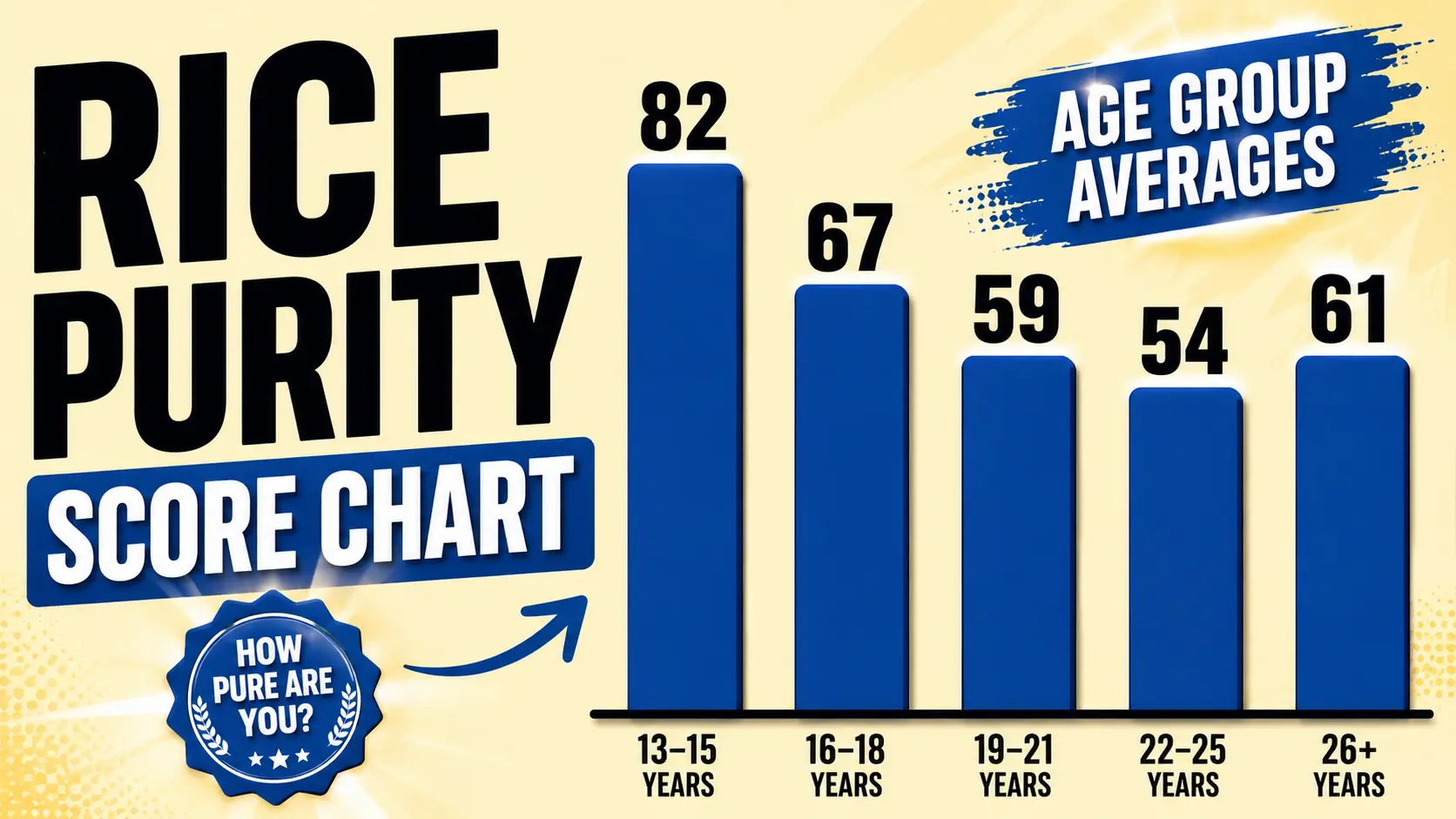
Scores decrease predictably as people age, since more life experiences accumulate over time. The table below reflects aggregated self-reported data from over 100,000 test results.
| Age Group | Average Score | Sample Size | Typical Range |
|---|---|---|---|
| 14–17 | 82 | ~15,400 | 72–90 |
| 18–22 (college) | 67 | ~38,200 | 58–76 |
| 23–29 | 59 | ~27,600 | 50–68 |
| 30–40 | 54 | ~14,300 | 45–63 |
| 41+ | 61 | ~8,500 | 50–70 |
The steepest score drop occurs between the 14–17 and 18–22 age groups — a 15-point average decline — reflecting the significant experiences that typically accumulate during college years. The slight uptick at 41+ may reflect more conservative self-reporting or different interpretations of certain questions by older adults.
Key Stat: 82 → 67
The average Rice Purity Score drops 15 points between the high school (14–17) and college (18–22) age groups — the steepest decline across any two consecutive age bands.
What Is a Normal Rice Purity Score?
There is no single “normal” score — it varies substantially by age. The table below gives the typical range for each life stage.
| Life Stage | Age Range | Typical Score Range |
|---|---|---|
| Early teen | 13–15 | 82–90 |
| High school | 16–18 | 72–84 |
| College student | 19–22 | 58–70 |
| Young adult | 23–29 | 50–64 |
| Adult | 30+ | 45–62 |
The most important rule: compare your score to your own age group, not to a universal benchmark. A 17-year-old with a score of 75 is well within the normal range. A 25-year-old with the same score is above average for their age group — not better or worse, simply different.
Average Rice Purity Score by Country
Scores vary by country, largely influenced by cultural norms around relationships, substance use, and personal behavior. Countries with more conservative social norms tend to produce higher average scores.
| Country | Average Score |
|---|---|
| Japan | 66.6 |
| Germany | 66.3 |
| Israel | 65.9 |
| United Kingdom | 65.7 |
| Ireland | 65.6 |
| Italy | 65.4 |
| Australia | 64.3 |
| United States | 63.9 |
| Netherlands | 63.7 |
| New Zealand | 63.3 |
| Brazil | 63.2 |
| Canada | 61.0 |
| Mexico | 60.1 |
| Spain | 59.3 |
| South Africa | 59.2 |
| Russia | 59.2 |
| France | 57.9 |
| Argentina | 57.4 |
The US average of 63.9 sits close to the global mean. France and Argentina show the lowest averages in this dataset, while Japan and Germany show the highest among the countries listed. Data sourced from aggregated self-reported results across multiple platforms — treat as informal benchmarks, not official statistics.
What Do Specific Rice Purity Scores Mean?
These are the most commonly searched specific scores and what each one means in context.
- Score 89 — High score. Very few boxes checked. Typical for younger teens or those with limited exposure to the test’s experience categories.
- Score 85 — Well above average. Relatively few items checked. Sits in the “good zone” and is most common among 16–18 year olds.
- Score 76 — Comfortable above-average. Some experiences, but far from the full list. Typical for late teens and early college students (17–20).
- Score 71 — Solidly above average. Typical for late teens. Reflects some experience but sits comfortably above the college-age average of 67.
- Score 69 — Edge of average. Right at the boundary between average and above-average. Very common for college students aged 19–22. Not to be confused with the actual question 69, which is a whole separate rabbit hole.
- Score 49 — Experienced. More than half the 100 items checked. Common for adults in their mid-to-late 20s with a broad range of life experiences.
Want to find your own number? Take the Rice Purity Test and get your result instantly.
What Does MPS Mean on the Rice Purity Test?
MPS stands for “My Purity Score.” It is the label certain versions of the Rice Purity Test use to display a user’s personal result after completing the quiz. MPS is not a separate scoring system — it simply refers to the individual’s score out of 100. The interpretation is the same: higher means more innocent, lower means more experienced.
Is There a Bad Rice Purity Score?
No. There is no bad Rice Purity Score. A low score reflects a greater number of life experiences — that is the complete extent of what it means. The test was designed as a social icebreaker in the 1920s, not a character assessment, a moral test, or a clinical instrument.
A score of 20 and a score of 95 are equally valid. They describe different experiences, not different values. If another person uses your score to judge you negatively, that reflects their interpretation — not any objective meaning the test carries.
Should You Care About Your Score?
The Rice Purity Test is designed for fun and social comparison, not for self-evaluation or judgment. Take it with friends, compare scores, and treat it as the lighthearted social quiz it was always intended to be.
There is no target score to aim for. There is no score to feel ashamed of. Your score reflects your experiences — and experiences are neither inherently good nor bad, only different. If you haven’t taken it yet, try the Rice Purity Test here and see where you land.
Frequently Asked Questions
A good Rice Purity Score is generally between 70 and 85. This range is above the overall average of 64–68, indicating some life experience without checking most of the 100 test items. Scores above 85 are considered very innocent, and scores in the 70–85 range are commonly described as the “good zone.” That said, “good” is subjective — any score is acceptable because the test does not carry moral value.
The overall average Rice Purity Score across all ages is approximately 64–68. For college students aged 18–22, the average is around 67. For teenagers aged 14–17, the average is approximately 82. Scores consistently decline as people age and accumulate more life experiences.
Not objectively. A higher Rice Purity Score means fewer experiences have been checked — it indicates relative innocence by the test’s definition. A lower score indicates more experiences. Neither is inherently better. The test reflects life experiences, not personal worth, character, or maturity.
For a 16-year-old, a normal Rice Purity Score is between 72 and 84. The average for the 14–17 age group is approximately 82, based on aggregated self-reported data from over 15,000 results. Scores within this range are entirely typical for high school students.
A Rice Purity Score of 49 means the person has checked more than half of the 100 test questions. This indicates a broad range of life experiences across the test’s categories — relationships, substance use, rule-breaking, and others. A score in this range is common for adults in their mid-to-late 20s.
An 85 Rice Purity Score is well above the overall average of 64–68. It places the person in the “good zone” — they have had some experiences on the test’s list but remain relatively innocent by the test’s standards. This score is most common among 16–18 year olds and is considered a high, above-average result.
There is no bad Rice Purity Score. The test is a social quiz that measures the number of experiences checked, not a moral or psychological assessment. A low score simply reflects more experiences — it does not indicate anything negative about a person’s character, values, or life choices.
MPS stands for My Purity Score. It is the label some versions of the Rice Purity Test display after you complete the quiz. It is not a separate scoring system — it is simply your personal result out of 100. The standard interpretation applies: higher score means more innocent, lower score means more experienced.
Yes. A Rice Purity Score of 70 is above the overall average of 64–68. It sits in the recognized good zone of 70–85, meaning the person has had some experiences but has not checked most of the 100 items. A score of 70 is considered above average for most age groups.
The Rice Purity Test was created at Rice University in Houston, Texas. The Rice Thresher student newspaper first published a version of the test in 1924, making it one of the longest-running social quizzes in American campus culture. It has since been adapted and distributed widely online.
Related Rice Purity Score Guides
- Is 70 a Good Rice Purity Score?
- Is 50 a Bad Rice Purity Score?
- What Does a 0 Rice Purity Score Mean?
